|
"Forget
You Not"™:
H o l o c a u s t
S u r v i v
o r s a
n d R e m e
m b r a n c e
P r o j e
c t
- Part IV -
|
 
T A B L E
O F
C O N T E N T S

|
|
< iSurvived.org >
|
|
< ForgetYouNot.org >
|
|
.
|
.
|
|
..
|
|
..
|
|
Courtesy
of The Danish Center for
Holocaust and Genocide Studies
|
|
<holocaust-uddannelse.dk>
<holocaust-education.dk>
|
IV. An Introduction to
Holocaust Studies, Anti-Semitism
and Related Topics
 
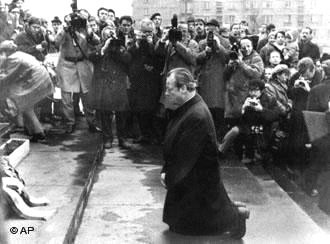
Willy
Brandt's Silent Apology
|
|
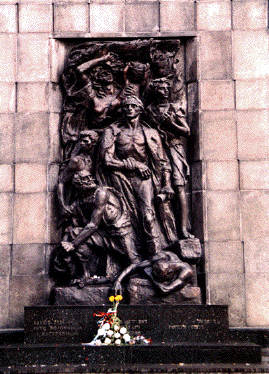
 On December 7,
1970, while in
Warsaw for a
commemorative
service
honoring the
participants
of the Warsaw Ghetto Uprising,
the German
Chancellor
Willy Brandt
kneels in
front of the Monument,
in an apparent
gesture of
apology,
repentance,
and
reconciliation.
On December 7,
1970, while in
Warsaw for a
commemorative
service
honoring the
participants
of the Warsaw Ghetto Uprising,
the German
Chancellor
Willy Brandt
kneels in
front of the Monument,
in an apparent
gesture of
apology,
repentance,
and
reconciliation.
|
|
|
Photo
Credit:
<dw-world.de/dw/article/0,2144,2144598,00.html>
|
German
Chancellor,
January
25, 2005.
|
The Yellow
Star:
The Persecution of the
Jews in Europe 1933-1945
.
The deportation of Dutch Jewry was
a
"pitch-black"
chapter in
Dutch history.
Prime Minister Jan Peter Balkenende,
at Yad Vashem,
March 2005
|
.
|
|
1. Pre-Holocaust
Studies
|
|
2.
Holocaust Studies
|
3. The
Ugly Face of
Anti-Semitism
|
4. Vatican
and the Holocaust
|
5. Other
Victims and Intended
Victims of the
Nazi Era
|
6. Comprehensive
List of Holocaust Study
Sources
|
7. War
Crimes and Holocaust
Related Trials
|
8.
Holocaust Denial on
Trial
|
9. Post
Holocaust Issues
|
10. Myths,
Unfounded Stories, and
Concocted
Representations About
the Holocaust
|
"  When you
study the Holocaust, When you
study the Holocaust,
you are studying the
highest level of organized
hate in the history of
mankind."
John Conway, Ph.D.,
Professor Emeritus of
History at the University
of British Columbia,
Canada,
Director of the
Association of
Contemporary Church
Historians
|
1. Pre-Holocaust
Studies
|
|
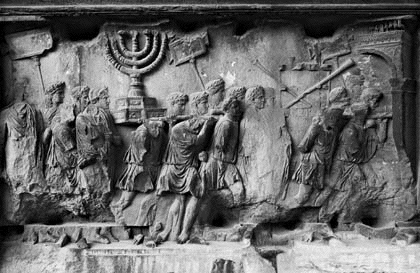
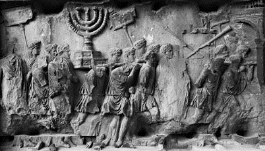
The
Israeli Coat of Arms
features the
Menorah, the
candelabra used in the
ancient Temple in
Jerusalem. It, along
with other Temple
artifacts, was captured
almost two millennia ago
by the Romans during
their siege of
Jerusalem.
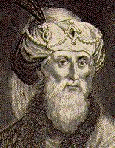
According
to the historian Flavius
Josephus, a Jew who
lived at the time of the
Romans, "Most of the
spoils that were carried
were heaped up
indiscriminately, but
more prominent than all
the rest were those
captured in the Temple
at Jerusalem - a golden
table weighing several
hundred weight, and a
lampstand similarly made
of gold but differently
constructed from those
we normally use. The
central shaft was fixed
to a base, and from it
extended slender
branches placed like the
prongs of a trident, and
with the end of each one
forged into a lamp:
these numbered seven,
signifying the honour
paid to that number by
the Jews." (Josephus,
The Jewish War, G.A.
Williamson, translator,
Penguin, 1959.)
The
Arch of Titus in Rome
has on it a carving
depicting the spoils of
the Temple - including
the Menorah - being
carried triumphantly
through Rome.
|
|
The Menorah
on the Arch of Titus,
Rome, Italy.
|
|
Courtesy of
Israeli Ministry of
Foreign
Affairs
|
|

|
|

2. Holocaust
Studies


- Why Study the
Holocaust?
-
|
United
States
|

|
|
Holocaust
Memorial Museum
|
|
- The Holocaust
Education Program Resource Guide
|
|
"When you
study
the Holocaust,
you are studying
the highest level of
organized hate
in the history of
mankind."
John
Conway,
Ph.D.
|
|
|
Understanding
the Holocaust leads to
understanding hate.
Studying the rise of the
Nazis and their
extermination of the
Jews and other social
undesirables is an
exploration into how
ordinary people can,
through mass persuasion
and social structural
constraints, be led into
committing genocide, the
ultimate horror in human
behavior. [Drs. Carol & Sam
Edelman,
California State
University, Chico, USA]
|
|
Jews Not
Wanted Here
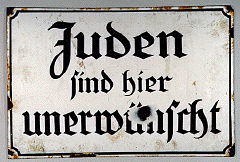
Signs excluding Jews,
such as the sign shown
here, were posted in
public places (including
parks, theaters, movie
houses, and restaurants)
throughout
Nazi Germany.
|
- From Yad Vashem:
Basic Bibliography
of the Holocaust
- From Simon Wiesenthal
Center:
The Holocaust,
1933-1945
T
H
E
H
O
L
O
C
A
U
S
T
|
Nazi
Germany, 1933-1938
|
T
H
E
H
O
L
O
C
A
U
S
T
|
- The
Courage To Remember
The Holocaust
1933-1945
- Why The
Jews? The Patterns of
Persecution
- 1933:
German Jewish Life
Before The Nazis
- The
"Jewish Question":
Nazi Policy 1933-1939
- The
Nightmare Begins:
Hitler And The Nazis
- Nazi
Propaganda Slogans,
Myths, and Images
- Nazi
Policy: Racism and
Terror
- Concentration
Camps 1933-1938
- In
Flight: 1933-1938
- 1938: The
Reich Expands
- Kristallnacht:
The Night of Broken
Glass
- Flight
Without Escape: The
Jewish Homeless
- The
Deadly Philosophy:
Racial Purity
|
|
Moving
Toward the "Final
Solution", 1939-1941
|
- All
Necessary
Preparations:
1933-1941
- Eastern
Europe: The Arena For
Mass Murder
- Isolate
and Destroy: The
Jewish Question in
Occupied Territory
- Days of
Nightmare: The Lodz
Ghetto
- The World
Turned Upside Down:
The Warsaw Ghetto
- Blitzkrieg:
The Invasion and
Occupation of The West
- No
Escape: Greece and
Yugoslavia Fall
- Whatever
Can Be Saved: Daily
Life In The Ghettos
|
|
Annihilation
in Nazi-occupied
Europe, 1941-1945
|
- The Final
Solution
- Death By
Design: The Invasion
of The Soviet Union
- Einsatzgruppen:
Mobile Killing Squads
- The Final
Choice: Resistance
- Resistance
and Revenge: The
Warsaw Ghetto Revolt
- Mass
Murder: 1942-1945
- Theresienstadt:
The "Model" Ghetto
- Like
Dying Candles:
Concentration Camp
Routine
- The
Enduring Spirit: Art
of The Holocaust
- Auschwitz-Birkenau:
The Death Factory
- Auschwitz-Birkenau:
Half Hell, Half
Lunatic Asylum
- The Last
Agony at Auschwitz:
Liberation, January
1945
- A
Righteous Few:
Survival in Hiding and
Rescue
- Liberation:
The Unmasked Horror
|
|
Liberation
- Building New Lives
|
- Bitterness
and Hope: The Legacy
of The Holocaust
- Crimes
Against Humanity:
Nazis on Trial
- Where
Now? Where to? The
Displaced
- Revival:
Building New Lives
- Remembrance
and Vigilance
|
|
36
Questions About the
Holocaust
|
|
~ From
Simon Wiesenthal
Learning Center ~
|
- The Holocaust --A
Guide for Teachers

|
JewishGen's
Holocaust Databases
A
collection of
databases
containing
information
about Holocaust
victims and
survivors.
It incorporates
nearly 100
datasets which
contain over one
million entries.
|
.
|
|
.From The
Danish Center for Holocaust
and Genocide Studies
|
|
.
|
.
Why did the
Nazis murder the Jews?
The
answer to this question is
highly debated among
historians. Some have stated
that it had always been
Hitler's plan to exterminate
the Jews, while others have
perceived the mass murders
as a result of a long and
curved process, where the
Nazi Jewish policy was
gradually radicalised.
The
Jews' presence in the
German-occupied parts of
Europe was seen as a problem
and a great annoyance. At
best, they were to disappear
from the face of the earth,
so that the Nazis could
reach their goal: a Greater
Germany free from Jews.
Different solutions were
tried: voluntary
immigration, forced
immigration, and several
different plans for
deportation. Plans surfaced
to deport all the Jews to
the east, first to eastern
Poland, then to Siberia.
Serious plans were also
developed that included
deporting all European Jews
to the island of Madagascar,
of the east coast of Africa.
All
these plans had to be
dropped, however, because of
the war. At the same time,
the Nazis had gained
experience with systematic
mass murder in the form of
the Euthanasia Programme,
where physically and
psychologically disabled
were killed by the state.
This constituted the
crossing of an important
psychological barrier.
Another such barrier was
crossed with the beginning
of the Germans' incredibly
cruel war of extermination
against the Soviet Union,
which commenced in June
1941. All usual conventions
for warfare were dropped at
the beginning of this 'the
final battle against
Judeo-Bolshevism'.
The
result of the frustrations
with the unsuccessful
deportation plans, of the
experiences with the
euthanasia actions, of the
war with the Soviet Union,
and not least of the wish to
find the 'Final Solution to
the Jewish Question' --all
these elements lead to the
systematic mass murder of
approximately 6 million
Jews.
.
|
.
|
|
.<www.holocaust-education.dk/holocaust/hvadhvemhvor.asp>
|
|
.From The
United States Holocaust
Memorial Museum
|
|
.
|
What is the
Origin of the Word
"Holocaust"?
The word
holocaust comes from the
ancient Greek, olos
meaning "whole" and kaustos
or kautos meaning
"burnt." Appearing as
early as the fifth century
B.C.E., the term can mean
a sacrifice wholly
consumed by fire or a
great destruction of life,
especially by fire.
While the
word holocaust,
with a meaning of a burnt
sacrificial offering, does
not have a specifically
religious connotation, it
appeared widely in
religious writings through
the centuries,
particularly for
descriptions of "pagan"
rituals involving burnt
sacrifices. In secular
writings, holocaust
most commonly came to mean
"a complete or wholesale
destruction," a
connotation particularly
dominant from the late
nineteenth century through
the nuclear arms race of
the mid-twentieth century.
During this time, the word
was applied to a variety
of disastrous events
ranging from pogroms
against Jews in Russia, to
the persecution and murder
of Armenians by Turks
during World War I, to the
attack by Japan on Chinese
cities, to large-scale
fires where hundreds were
killed.
Early
references to the Nazi
murder of the Jews of
Europe continued this
usage. As early as 1941,
writers occasionally
employed the term holocaust
with regard to the Nazi
crimes against the Jews,
but in these early cases,
they did not ascribe
exclusivity to the term.
Instead of "the
holocaust," writers
referred to "a holocaust,"
one of many through the
centuries. Even when
employed by Jewish
writers, the term was not
reserved to a single
horrific event but
retained its broader
meaning of large-scale
destruction. For example:
You are
meeting at a time of great
tragedy for our people. In
our ... deep sense of
mourning for those who
have fallen ... we must
steel our hearts to go on
with our work ... that
perhaps a better day will
come for those who will
survive this holocaust.
(Chaim Weizmann, letter to
Israel Goldstein, December
24, 1942)
What sheer
folly to attempt to
rebuild any kind of
Jewish life [in Europe]
after the holocaust of
the last twelve years!
(Zachariah Shuster,
Commentary, December
1945, p.10)
By the late
1940s, however, a shift
was underway. Holocaust
(with either a lowercase
or capital H) became a
more specific term due to
its use in Israeli
translations of the word sho'ah.
This Hebrew word had been
used throughout Jewish
history to refer to
assaults upon Jews, but by
the 1940s it was
frequently being applied
to the Nazis' murder of
the Jews of Europe.
(Yiddish-speaking Jews
used the term churbn, a
Yiddish translation of
sho'ah.) The equation of
holocaust with sho'ah was
seen most prominently in
the official English
translation of the Israeli
Declaration of
Independence in 1948, in
the translated
publications of Yad Vashem
throughout the 1950s, and
in the journalistic
coverage of the Adolf
Eichmann trial in Israel
in 1961.
Such usage
strongly influenced the
adoption of holocaust
as the primary
English-language referent
to the Nazi slaughter of
European Jewry, but the
word's connection to the
"Final Solution" did not
firmly take hold for
another two decades. The
April 1978 broadcast of
the TV movie, Holocaust,
based on Gerald Green's
book of the same name, and
the very prominent use of
the term in [United States
President] Jimmy Carter's
creation of the
President's Commission on
the Holocaust later that
same year, cemented its
meaning in the
English-speaking world.
These events, coupled with
the development and
creation of the United
States Holocaust Memorial
Museum through the 1980s
and 1990s, established the
term Holocaust
(with a capital H) as the
standard referent to the
systematic annihilation of
European Jewry by
Germany's Nazi regime.
|
.
|
|
.<www.ushmm.org/research/library/faq/details.php?topic=01#02>
|
-
|
|
While
Nazi Germany proceeded
to
systematically round up
and execute Jews,
the rest of the world
closed its eyes and its
doors.
|
|
by
Rabbi Ken Spiro
|


- Euthanasia --the
'Mercy Killing' of Disabled People
in Germany
- Nazi Persecution of
the Mentally and Physically Disabled
- T4 - Hitler's
Murder Program
- Children and the
Holocaust
- The Holocaust
Revisited:
A Retrospective Analysis of the
Auschwitz-Birkenau Extermination
Complex
(with
Aerial Reconnaissance Imageries)
- Studies on the
Holocaust: The Assault on Humanity
From Prejudice & Ideology to
Murder, Genocide & Shoah
Lectures by Edith
Shaked, Pima Community College,
Tucson, Arizona, USA.
- The Evolution of
Tattooing in the Auschwitz
Concentration Camp Complex
- The Wannsee List
|
.
|
|
|
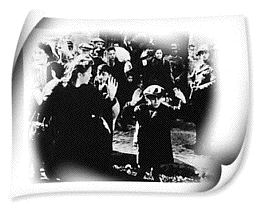
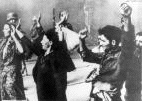
Jewish
underground fighters who
fell into German hands
during the suppression of
the Warsaw Ghetto
uprising.
|
|
|
.
|
|
|
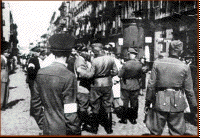
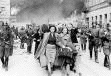
Jewish
Civilians Rounded up in
the Warsaw Ghetto.
|
|
|
Of all the occupied countries,
the percentage
of Jews saved
in Poland
was the
smallest,
since the
predominant
attitude was
hostile, while
rescue was an
exception to
the rule.
[Isaiah
Trunk]
|
|
Slovakia
was the only
country that
paid
Nazi Germany
to deport its
Jews.
|
|
|
Prior to WW II, there were approximately
140,000 Jews
living in The Netherlands,
but by war's
end, over
100,000 Dutch
Jews had been
murdered ...
most by the
Nazis ... but
some by Dutch
collaborators.
Seventy
five percent
of Dutch Jews
perished
during the
Holocaust, the
highest
percentage in
any country in
Nazi-occupied
Europe, except
for Poland.
<jewishwebindex.com/holland.htm>
|
|
WHY 80 percent
of the Italian
Jews survive
the Holocaust
while 80
percent of the
Jewish
population in
other parts of
Europe perish?
|
|
- The S.S. St. Louis
after 60 Years
- The Dachau Gas
Chambers
by Harry W. Mazal OBE
- An Essay on the
Dachau Gas Chambers (with First
Hand Documentation)
J
E
W
I
S
H
R
E
S
I
S
T
A
N
C
E
|
|
-
|

|
Not much is
known about
Belzec Concentration Camp,
where one million Jews
perished.
No one survived to tell its
stories.
Rabbi Shaul Rosenblatt
|
- Oral and Written
Testimonies: Lithuania and the
Holocaust
- Two Studies on the
History of the Jewish Community in
the city of Grodno, Belarus:
- 1. Lost Jewish
Worlds: The Communities of Grodno,
Lida, Olkieniki, Vishay
- 2. Documents
Concerning the Murder of 29000
Jews of Grodno By the Germans,
1941-1943
- A Forgotten
Chapter: Holland Under the Third
Reich
- Why Did Denmark
Jews Survive While Dutch Jews Died
in the Holocaust?
- Holocaust: The
Untold Story
-
|
From
Encyclopædia Britannica:
|
|
|
.
|
- From PBS: America
and the Holocaust (Primary Documents)
|
1.
Barring U.S. Doors To
Aliens/Refugees
2. News Of
Extermination Reaches U.S.
3. President
Roosevelt's Apparent
Reluctance To Help
Europe's Jews
4. Bermuda
Conference
5. Something Can
Be Done: War Refugee Board
6. Bombing Railways
And Auschwitz
|
- Half-Century Later,
a New Look at Argentine-Nazi Ties
- Greater Bulgaria,
Macedonia, and the Holocaust
- Hungary After the
German Occupation
|
|
|
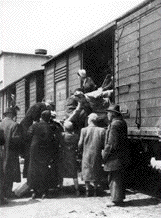
June
15, 1944:
Hungarian Jews
deported to
Auschwitz
|
|
|
- Hitler's Plans for
Eastern Europe
Selections from Janusz Gumkowkski and
Kazimierz Leszczynski, "Poland Under
Nazi Occupation"
- Jewish History of
Poland During the Holocaust Period
ROMANIA
DURING THE
HOLOCAUST YEARS
- From
Yad Vashem:
Romanian-German Relations Before and During the
Holocaust
- The Holocaust Period in Romania
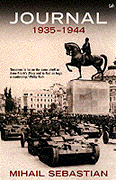
- The Holocaust in Romania
- From
Yad Vashem:
Romania: The Journey To Truth
- From
Yad Vashem:
An Introduction to The National Romanian Legionary
State
and Its Attempt to Solve the "Jewish Question"
- An Introduction to the Infamous Iron Guard of Romania
|
The
Iron Guard
were
particularly
infamous for
the virulence
with which
they
participated
in what was
later to
become known
as the
Holocaust.In The Destruction
of the
European Jews,
Raul Hilberg
writes, "There
were...
instances when
the Germans
actually had
to step in to
restrain and
slow down the
pace of the
Romanian
measures." The
annihilation
of the Jews of
eastern
Romania
(including
Bessarabia,
Bucovina,
Transnistria,
and the city
of Iasi) had
more the
character of a
pogrom than of
the
well-organized
brutality of
the transports
and camps.
|
|
The Bucharest Pogrom:January 21 - 23, 1941
|
|
.
|
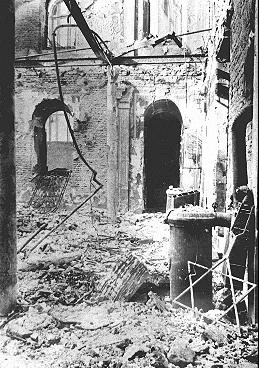
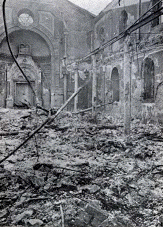
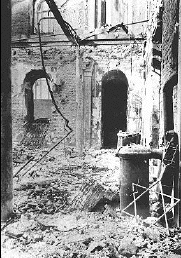
The
Jewish Spanish
Temple in
Bucharest,
Romania, after
being looted,
is burn to the
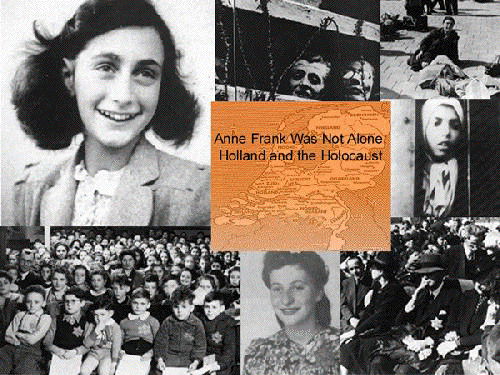
ground.
|
|
|
Sephardic
synagogue
destroyed
during the
January 21-23
Iron Guard
pogrom.
Bucharest,
Romania,
January 1941.
|
|
|
|
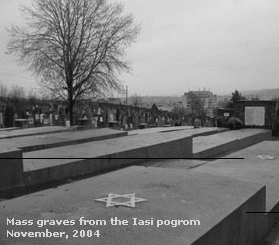
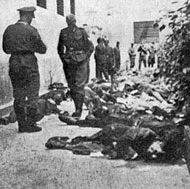
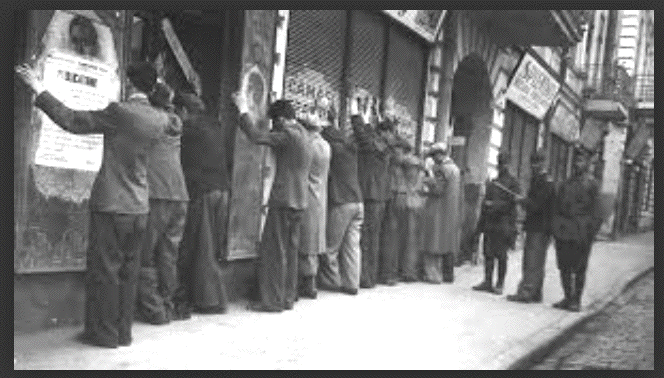
A
scene from the
Vasile
Alecsandri
Street located
near Unirii
Square in
Iasi, Romania
on
June 29,
1941
|
|
|
<ushmm.org/wlc/media_ph.php?lang=en&ModuleId=10005183&MediaId=853>
<ziaruldeiasi.ro/cms/site/z_is/news/aruncat_de_viu_in_mormint_145051.html>
|
- Romanian Jews Remember the Killings
|
Holocaust
survivor and
renown writer
Victor
Barladeanu
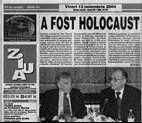
remembers when
his family of
some 20 people
had to hid in
the attic to
escape from
the mobs...
|
|
|
|
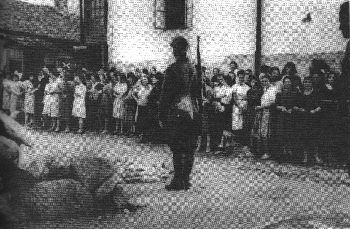
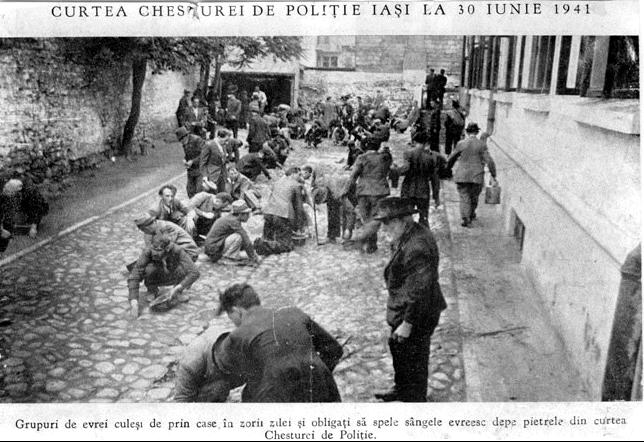
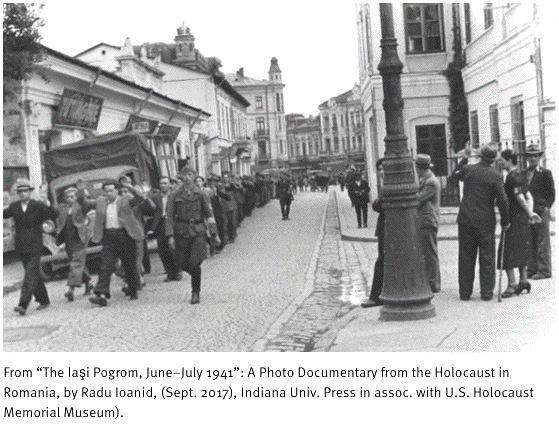
Jews
in front of
the Police
Station
Building in
Iasi, Romania,
being forced
to scrub the
street
pavement in
cleaning up
the Jews
blood.
(June 30,
1941.)
<www.ziaruldeiasi.ro/cms/site/z_is/news/aruncat_de_viu_in_mormint_145051.html>
|
|
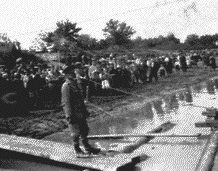
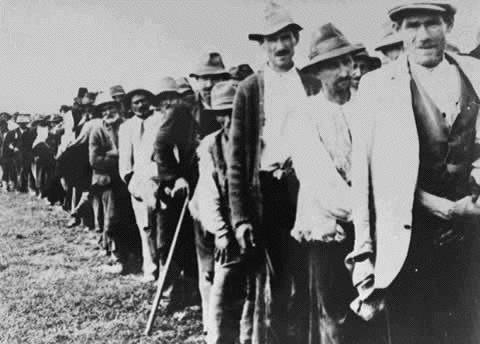
Deportation
of Romanian
Jews
from Gura
Humorului to
Transnistria
under the
direct orders
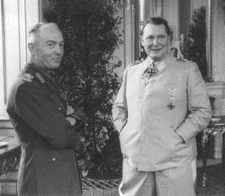
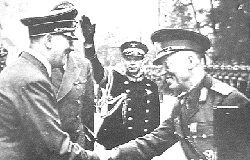
of Marshal Ion
Antonescu
|
|
 . .
The Sinking of MV Struma
|
|
|
|
|
|

|
|
|
|
|
- Romania and the Holocaust
- From Yad Vashem:
Romanian-German Relations Before and During the
Holocaust
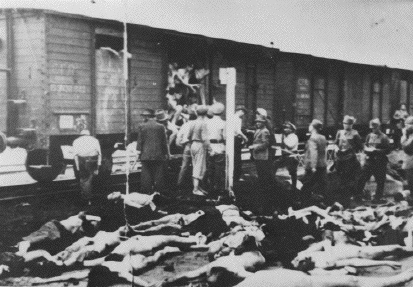
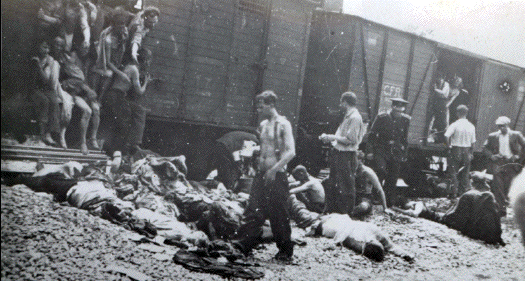
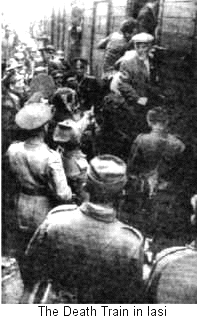
- Romanian Jews Recall "Death Trains"at Podul Iloaiei,
Romania
- Radauti, Romania --once with a thriving Jewish
Community
completely
decimated
- The Anatomy of a Massacre: Sarmas, Romania 1944
- Romania's Wartime Past During the Holocaust as Revealed
through these
entries:
Ref. 1,
Ref. 2,
Ref. 3,
Ref. 4,
Ref. 5,
Ref. 6,
Ref. 7,
Ref. 8,
Ref. 9,
Ref. 10,
Ref. 11, and,
a Photo Exhibit and a Photo Album
- Nazi hunt yields Romania war crimes suspects
|
|
|
|
.
|
|
THE
HOMOSEXUALS DURING THE
HOLOCAUST YEARS
|
|
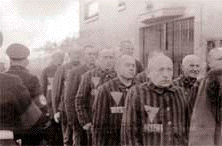
Homosexual
prisoners in Sachsenhausen,
1938
(NARA:
242-HLB-3609-25)
|
|
.REFLECTIONS
ON THE HOLOCAUST YEARS
|
|
3. The
Ugly Face of Anti-Semitism
Unleashed with Full Furry
Before, During, and After
the Holocaust...
|
|
Anti-Semitism
-- A History of
Hate as the
World's Longest
Hatred
|
|
Anti-Semitism,
strictly defined
as prejudice
directed at the
Jewish people, has
existed in one
form or another
ever since
Judaism's
beginnings. Often
referred to as the
oldest hatred,
anti-Semitism
originally was
based on the
mistrust of a
religion whose God
is invisible and
all-powerful. Even
today, the
anti-Semite uses
the word "Jew" not
in religious
terms, but in
social, economic
and political
contexts. [Florida
Holocaust Museum]
|
|
.

|
Some
Pictures from
the Nazi Era
that Can Speak
Volumes...
|
|
|
|
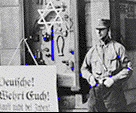
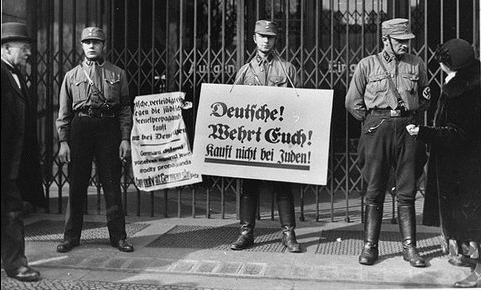
Nazi
storm troopers
block the entrance
to a Jewish-owned
store in Berlin.
|
Their
signs read:
"Germans, defend
yourselves against
the Jewish
atrocity
propaganda, buy
only at German
shops!" and
"Germans, defend
yourselves, buy
only at German
shops!"
|
|
(Credit:
U.S. National
Archives, William
Blye Collection,
and
USHMM)
|
|
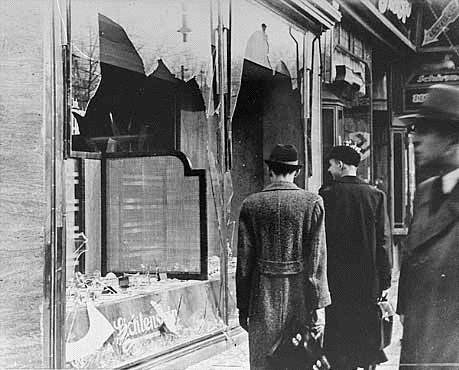
The
coordinated Nazi
vandalism of Kristallnacht
( "The Night of
Broken Glass") :
Night of Nov.
9-10, 1938 when
Jewish shopwindows
were smashed all
over Nazi Germany.
|
|
.
|
|
|
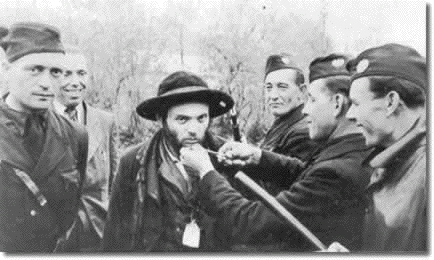
Some
Nazi fun
|
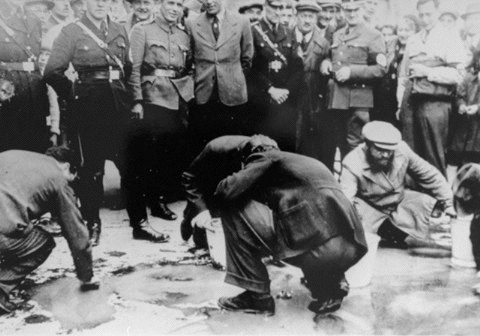
.Humiliation
of Jews in
Vienna,
Austria of
1938
.
|
|
|
|
|
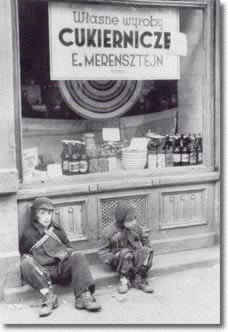
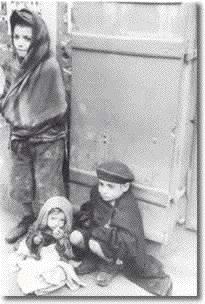
Jewish
Polish
Children
struggling to
survive
|
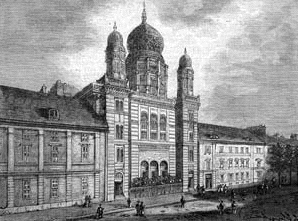
Largest
Synagogue in
the World
Destroyed
During
'Kristallnacht'
|
|
The
largest
synagogue in
the world when
completed in
1866, the
'Neue Synagogue'
in Berlin was
burnt on
'Kristallnacht',
9th of
November 1938,
and further
destroyed by
air raids in
1943. The
synagogue,
built in
elaborate
Neo-Moorish
style, was one
of the most
impressive of
all 19th
century
European
synagogues,
and indeed,
the largest
synagogue in
the world when
completed, it
seated some
3,200
congregants.The
exterior was
restored in
the late
1980s, and the
building
reconstructed
as a community
centre for
Berlin's
re-emerging
community,
following the
fall of East
Germany and
communist
Soviet Union.
|
<movinghere.org.uk/galleries/roots/jewish/holocaust/holocaust.htm>
|
|
|
.
|
|
|
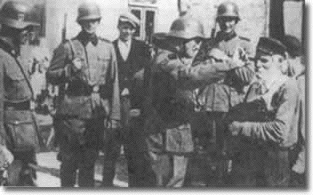
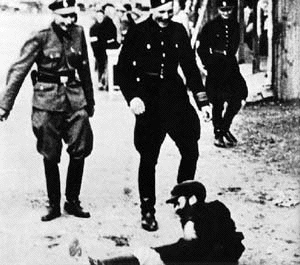
Nazis
soldiers
having some
fun...

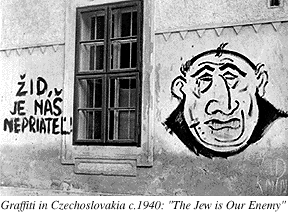
[From
Yad Vashem
Archives]
|
.
|
.
|
|
The Anti-Semitic Poland
and the Holocaust
|
P
O
L
A
N
D
P
O
L
A
N
D
P
O
L
A
N
D
|
- Fallout
from the War:
Anti-Semitism in Poland
- Take
Radzilow, Poland
During the Holocaust
- THE
JEDWABNE AFFAIR
|
. .
|
|
- Take
Jedwabne in Poland
During the Holocaust
and
the
Government's
Meaningless Apology
Towards Jews after
the Holocaust
(victims
are remembered by
the Polish President
but no one is blamed
for the massacre
-sic!)
- Poles
Face Truth of
Jedwabne:
1,600
Jews Slain by
Neighbours --
not Nazis
- The
60th Anniversary
of the Jedwabne
Pogrom (July 10,
1941)
- Pole
Position:
The
Anniversary of
the Infamous
Jedwabne Polish
Pogrom
Prompts
Debate, Soul
Searching
- Voices
on the Jedwabne
Tragedy
(A Comprehensive
Reference Listing)
- Reflections
on the Jedwabne
Debate
- The
Kielce Pogrom of
July 4, 1946
 Editor's
Remarks on
Poland's
Deep-Rooted
Anti-Semitism
Editor's
Remarks on
Poland's
Deep-Rooted
Anti-Semitism
|
And
a Response
with Love ...
|

Open
Letter to Mr.
Brattman
"Polish
mothers should
spell your
name to their
children,
to imprint in
them a fear of
a Zionist
monster."
from
a Canadian,
Polish-born, Dr.
Piotr Bein,
a
self-proclaimed
"Dr." and
"specialist"
in de-bunking
propaganda.
Anti-Semitism and The
Holocaust
<karisable.com/crnazi.htm>
|
Poland was Germany's dress rehearsal for the
slaughter of
Jews...
|
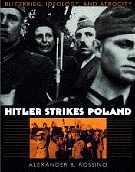
.Hitler
Strikes
Poland:
Blitzkrieg,
Ideology, and
Atrocity
by Alexander
B. Rossino
Publisher: University Press of Kansas (2003)
.
|
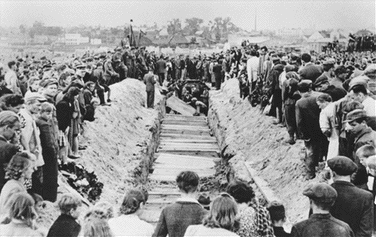
Poland, One Year After Auschwitz, Being Involved
In the Worst
Peacetime
Pogrom in
20th-century
Europe
|
|
Jews
being buried
in Kielce,
Poland, in
1946 --one
year after the
Nazi Holocaust
ended, as a
result of the
Kielce
massacre
committed by
ordinary
Polish
citizens
against their
own
neighbouring
Jews that were
able to
survive the
Holocaust.
To
squash these
revelations,
the 2008
Public
Prosecutor of
Krakow, Poland
announced that
it will
prosecute
anyone under a
2006 law
prohibiting
anyone from
asserting that
"the Polish
nation" was
involved in
crimes or
atrocities
committed by
Nazis or
communists.
Yes,
facing the
truth is not
easy for a
nation where
the
Anti-semitism
appeared to be
part of its
fabric. The
Polish poet
Czeslaw Milosz
once said that
Poland's
Communist
rulers
fulfilled the
dream of
Polish
nationalists
by creating an
ethnically
pure state.
That was in
the end
Hitler's
ultimate dream
--that of
creating an
ethnically
"pure" Europe.
|
|
The
Kielce Pogrom
triggered a
massive
westward
migration of
hundreds of
thousands of
Jews who had
survived
the Holocaust.
The movement,
known as the
Brihah,
brought Jews
from Poland
and other
eastern
European
countries to
Displaced
Persons Camps
(DPCs) located
in the western
zones of
occupied
Germany and
Austria, and
in Italy. [US Holocaust Memorial Museum]
|
|
|
|
From
Polish
Center for
Holocaust
Research:
|
|
The
Holocaust
happened on
our soil
[Poland], in
full view of
the Polish
society. The
Holocaust is
an integral
part --whether
one wants it,
or not-- of
Polish
history. For
Poles, the
experience of
the Holocaust
remains a
unique event
and carries
with it
extraordinary
responsibilities.
Nevertheless,
in terms of
social
awareness,
Shoah seems to
belongs to
Jewish rather
than to Polish
history. Even
today many
Poles feel ill
at ease,
threatened or
outright
disappointed
by the Jewish
perceptions of
the Holocaust
and oftentimes
the Jews are
seen as rivals
in the
martyrology
competition.
Despite the
recent
historical
research and
public
debates,
culminating
with the
discussion
around the
Jedwabne
crime, Polish
society
largely
ignores the
issues related
to the
Holocaust.
Still too many
myths and lies
are finding
their way to
the public
sphere and
enter public
circulation.
|
|
<holocaustresearch.pl/index1(en).htm>
|
- Poland's
Wartime Past During the
Holocaust
-
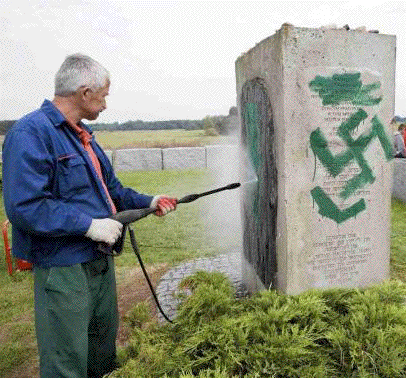
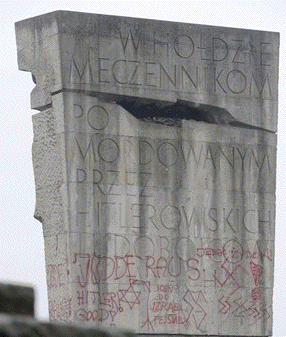
On
the August 31, 2011
Vandalization of the
Jedwabne Jewish
Monument
.
|
From
the Current Krakow Church
of Poland:
"The
Kikes Will Not Continue
to Spit on Us."
February
2008
|
.
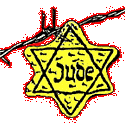
The New
Anti-Semitism: Subtle and
Coded
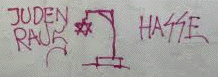
|
|
.
|
Kings,
pharaohs, generals,
fuehrers, Moslem extremists,
and more have tried to
exterminate the Jews for
millennia. The Bible
predicts the persecution of
both Jews and Christians in
many Scriptural references,
with an intensification in
the "end-times." The Arab
world fans the flames of
anti-Semitism, as well as
much of Europe and even
Canada.
It has
become more obvious in
America with the push for a
Palestinian state. Many,
though certainly not all,
who are pushing in America
for a Palestinian state, and
particularly on U.S.
campuses, have anti-Semitic
sentiment.
|
.
|
|
|
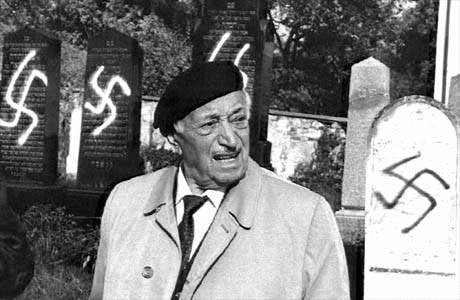
In
1992, the late Simon Wiesenthal at
a Jewish
cemetery in
Eisenstadt,
Austria, that
had been
vandalized by
right-wing
extremists. [European
PressPhoto
Agency]
|
|
.
|
|
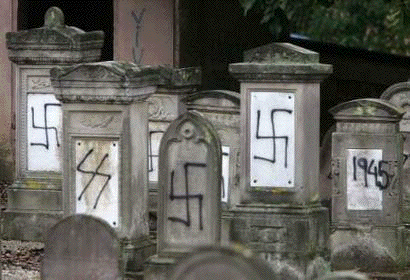
Neo-Nazi
defacement of
Jewish cemetery
of Brumath,
close to
Strasbourg,
France,
October 31,
2004..
[Reuters]
<en.wikipedia.org/wiki/Image:FrenchCemetery103004-01.jpg>
<worldjewishnewsagency.org/hero_of_the_jewish_people__serie.htm>
|
|
|
|
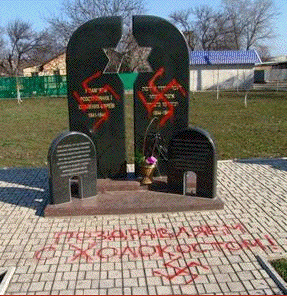
Unidentified
people
desecrated the
Holocaust
monument in
Odessa,
Ukraine late
Sunday,
February 18,
2007 with red
swastikas and
with an
inscription:
"Congratulations
on
the Holocaust."
|
.
|
- From United
States Holocaust Memorial
Museum:
Anti-Semitism
--A Continuing Threat
- The
Canary in Europe's Mine
by Jeff
Jacoby of The Boston Globe
|
In
the aftermath of
the Holocaust,
open Jew-hatred
became
unfashionable;
but fashions
change, and
Europe is
reverting to
type.
|
The
Nazis first set
out to
incinerate the
Jews; in the
end, all of
Europe was
ablaze.
|
- Background
Information on the New
Anti-Semitism
- Anti-Semitism,
The Pipeline of Hatred
- The
Multiple Faces of
Anti-Semitism

- Anti-Semitism:
How Deep are the Roots?
- A
Shameful Contagion of
Anti-Semitism in Europe
- A New
Antisemitism?
by Rabbi
Professor Jonathan Sacks,
Chief Rabbi of the United
Hebrew Congregations of the
Commonwealth, London, UK.
- The New
Face of Anti-Semitism
- The "New"
French Anti-Semitism
- Selected
Articles on the New,
Modern Anti-Semitism
- Nazi Chants During Soccer Game in Germany -- October,
2006
- Mass Murder of Jews Planned in Prague -- October, 2006
- The Six Million Person Question--WSJ---Oct. 4 --
October, 2006
- The New Anti-Semitism---Sept. 28 -- September, 2006
- The Islamization of European Anti-Semitism --
September,
2006
- Anti-Semitic Hate Wave -- September, 2006
- Moving On to Anti-Semitism -- September, 2006
- Venezuela's Jews Fear Anti-Semitism -- August, 2006
- Dousing the Flames of Anti-Semitism -- August, 2006
- Driven to Aliya (Anti-Semitism)---Aug. 18 -- August,
2006
- Iran Unveils Holocaust Cartoon Contest--Fox---Aug. 15
-- August,
2006
- Mel, Kofi, and Me -- August, 2006
- Anti-Zionism Equals Anti-Semitism -- July, 2006
- In Spain, Anti-Semitism is a New Leftist Trend -- July,
2006
- Apocalyptic Muslim Jew Hatred -- July, 2006
- European Anti-Semitism Makes Horrible Comeback--C.
Today -- June,
2006
- How One Jewish Believer Escaped Hitler's Hell -- May,
2006
- Jew-Hatred: France's National Sport -- May, 2006
- Holocaust Denied by Alabama Candidate -- May, 2006
- Never Again? Krauthammer -- May, 2006
- Denying the Holocaust--WND -- April, 2006
- Europe Cautiously Welcomes Kadima--J. Post -- March,
2006
- Anti-Semitism High in Canada -- March, 2006
- Why the World Hates Jews -- March, 2006
- Ilan Halimi and Jews Leaving Europe -- March, 2006
- The Barbarians of Europe -- February, 2006
- Every Jew is on the Frontlines of War -- February, 2006
- The War Against (Dead) Jews -- February, 2006
- Hugo Chavez Veers into Anti-Semitism--Weekly Standard
-- February,
2006
- The Anti-Semitic Divestment Campaign -- February, 2006
- Iran's Holocaust Cartoon Contest -- February, 2006
- I'ts Us Who Should be Offended--JWR -- February, 2006
- Wake Up and Smell the Gunpowder -- February, 2006
- "Cool" Anti-Semitism -- January, 2006
- Growing Anti-Semitism in U.S. Schools -- December, 2005
- Wolfensohn: Israel Threatens Peace Process -- October,
2005
- "Never Remember" the Holocaust -- September, 2005
- Leftist Jew Haters--Horowitz -- August, 2005
- WCC Says Divestment Not Anti-Semitic (!) -- July, 2005
- Disciplined for Opposing Anti-Semitism in U.K. -- June,
2005
- United Methodist Church Divests from Israel -- June,
2005
- Leftist Campusus and Politically Correct
Anti-Semitism--CBN
-- May, 2005
- Celebrating the Miracle of Survival -- May, 2005
- Reflections on Yom HaShoah -- May, 2005
- The Church of Anti-Semitism -- April, 2005
- The Terrifying Resurgence of European Anti-Semitism --
March, 2005
- Anti-Semitic Attacks Up 42% in One Year in U.K. --
March, 2005
- Mainline Christian Anti-Semitism -- March, 2005
- Caving in to Hezbollah--Wash. Times -- March, 2005
- Iran:Don't Risk All Middle East Oil -- March, 2005
- Visas for Terror--Mowbray -- March, 2005
- Anti-Semitism Re-visited -- February, 2005
- The Face of Anti-Semitism--Jacoby -- February, 2005
- A Third Intifadeh--NewsMax -- February, 2005
- World Council of Churches Calls for Israel Divestment
-- February,
2005
- British Press Fuels U.K. Anti-Semitism -- February,
2005
- The New Anti-Semitism--Pipes -- February, 2005
- Attacks on British Jews Hits New High -- February, 2005
- Dominion Theology and Anti-Semitism--Ice -- January,
2005
- The Religious Left and the Holocaust -- January, 2005
- British Muslims Cheapen the Holocaust -- January, 2005
- Enlightened Europe Has Jew-Hatred Out of Control--JWR
-- January,
2005
- So, We're Hated--Prager -- January, 2005
- Anti-Semitism, the Church and the Last Days--Kinsella
-- January,
2005
- Europe Alarmed at Leap in Anti-Semitism -- December,
2004
- Rabbi to Jews: Leave Europe -- December, 2004
- Fatal Failure: Not Seeing Anti-Zionsim is
Anti-Semitism--NRO
-- December,
2004
- As Attacks Rise In France, Jews Flee To Israel --
November, 2004
- CNN: Blame The Jews! -- November, 2004
- How Academia Declared Open Season On The Jews --
October, 2004
- Anti-Semitism Bill Opposed By State Department--WND --
October, 2004
- The New Anti-Semitism--Wash. Times -- October, 2004
- The Koran And Anti-Semitism -- June, 2004
- "This Reminds Us Of The 1930's"--J. Post -- April, 2004
- White Europeans Behind Anti-Semitism, Not Europe's
Muslims --
April, 2004
- Over 1500 Anti-Semitic Attacks in U.S. In 2003 --
March, 2004
- The Longest Hatred--Christianity Today -- March, 2004
- Canadian Anti-Semitism--Christian Embassy, Jerusalem --
March, 2004
- Is The Gospel Anti-Semitic? -- March, 2004
- Is European-Style Anti-Semitism Coming to America?--NRO
-- March, 2004
- Anti-Semitism In 3D--Natan Sharansky -- February, 2004
- Expose Anti-Israelism For What It Is -- February, 2004
- Henry Ford's Legacy -- December, 2003
- College Film Festival: Kill The Jews -- December, 2003
- The Scourge Of Anti-Semitism Spreads Its Venom --
December, 2003
- Woolsey: Hatred Of Jews Threatening Rule Of Law --
November, 2003
- On Hating The Jews: The Link Between Anti-Semitism
&
Anti-Americanism
-- November,
2003
- A New Form Of Anti-Semitism--Kinsella -- November, 2003
- Graffiti On History's Wall -- October, 2003
- Anti-Semitism's Global Comeback -- October, 2003
- The Anatomy Of An Anti-Semite -- October, 2003
- Who Hates Israel Now? -- October, 2003
- Time To Sound The Alarm -- October, 2003
- The Scariest Time For Jews Since The Holocaust --
October, 2003
|
- Selected
website on Anti-Semitism
- From
Scholars for Peace in the
Middle East:
On
Anti-Semitism in Academia
- Anti-Semitism
in Swedish Academia: The
Bergman Affaire
- A
Troubling Upsurge of
American Anti-Semitism
- THE NEW
ANTI-SEMITISM: The Current
Crisis and What We Must Do
About It
- Anti-Semitism/Anti-Israel
On Campuses
- Anti-Semitism
On US Campus
- Schooled
in Hate: Anti-Semitism
on Campus
- Anti-Semitism
On Campus: Past and
Present
|
The new anti-Semitism is a much quieter and more
insidious
force. It
comes from a
newly-emerging
American
ideology
dictating that
anything goes
as long as
you're
attacking the
people in
power.
|
- Anti-Semitism
on Campus by Harvard
University Professor
Ruth R. Wisse
|
Hundreds of university presidents have either spoken
out publicly
or signed a
statement
deploring the
presence of
anti-Semitism
on campus. But
none has tried
to explain the
phenomenon,
much less
undertaken to
do anything
about it
|
- Free
Speech and Hate Speech
at Duke University
(USA) , Round I
- Damage
Control, Tulane Style
(USA)
|
Plater
Robinson,
Education
"Specialist"
and Director
of Education
of The
Southern
Institute for
Education
& Research
of Tulane
University,
New Orleans,
LA , USA, who
has
next-to-zero
academic
credentials
(no Ph.D.
degree of any
known
accredited
school) upon
challenging
"in the name
of informing
us" the
credibility of
the
information***
posted in the
celebrated Auschwitz Album
as a result
perhaps of our
posted Birkenau-Auschwitz
Photo Montage,
wished us,
apparently in
tune with the
school's
spirit of
promoting
"tolerance,"
this much in
one of his
"academic" and
"educational"
emails
(of March 15, 2005):
|
i
was sharing
knowledge
which i
thought you
might
appreciate.
'may all your
teeth fall
out, except
one: to give
you a
toothache.'
you jerks
|
***The
information
challenged
apparently is
in regard to a possibility
that a man
identified as
a "Dutchman"
in the
Auschwitz
Album could,
in fact, be the
Polish
Holocaust
survivor Sigmund
(Siggy) Boraks
that currently
resides in New
Orleans and
who was
interviewed by
Mr. Robinson.
[What
possible
relevance
Mr. Robinson's
information
has,
of course,
is anybody's
guess.]
|
- Boston
University Chancellor
Responds to Holocaust
Deniers' Ads in Campus
Papers
- Senate
Hearing focuses on
anti-Semitism
allegations at St.
Cloud State University
(USA)
- Dr.
Alan.Anderson's Selected
Links for the students of
Western Kentucky
University (USA)
studying the Anti-Semitism
and the Holocaust
- Hateful
Ideas Can Spread, But Also
Be Refuted, on Internet
by
U.S. Law Professor Ronald
Rychlak
- Antisemitism:
A Wound to be Healed
by Walter
Cardinal Kasper, President,
Commission for Religious
Relations with the Jews.
- France: A
Country Infused With
Anti-SEmitic Hate
.by Daily Mail
Foreign Service, UK.
|
|
.
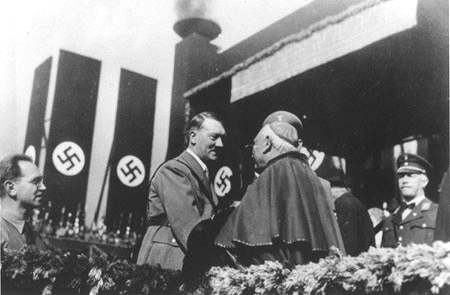
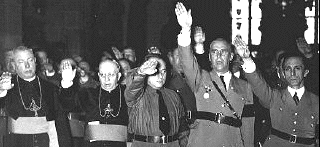
|
4. Vatican
and the Holocaust
|
|
|
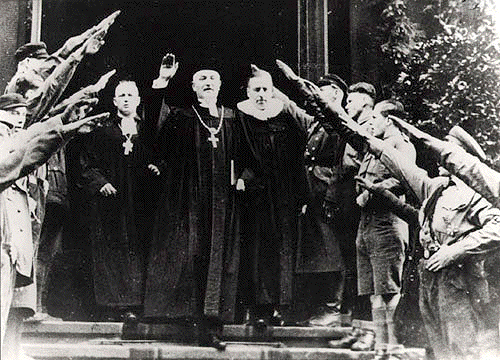
.Messengers of
Christianity During the
Holocaust Years
|
|
Forgiveness
has its
limits...
|
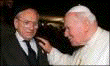
Pope John Paul II
greets World War II death
camp survivor JerzyÝKluger
1998
Vatican Apologies
Polish
Church Apology Over
The Holocaust
|
|
Submitted
to The Holy
See's
Commission for
Religious
Relations with
the Jews
and the
International
Jewish
Committee for
Interreligious
Consultations
by the
International
Catholic-Jewish
Historical
Commission
(October,
2000.)
|
|
.
|
|
|
An examination of the behavior of the Polish Church
leaders in
Occupied
Poland.
From
Yad Vashem --The Holocaust Martyrs' and Heroes' Remembrance
Authority
|
|
.
|
|
|
"It
can be called
a drama of
history that
Jesus, who
symbolizes the
bond of unity
between Jews
and
Christians,
has all too
often become
the sign and
the origin
of dissension
and even
violence
between these
faith
communities."
|
|
|
|
|
Current Focus on Dachau and its Protestant Church of
Reconciliation:
A Grotesque Display of Religion on the German Soil or
Is it
Something
Else?
.
|
|
.
|
- Christians and the Holocaust
By Sir Martin Gilbert, Jewish historian and biographer
of Sir Winston
Churchill,
that gave a
detailed
account of
Christians who
rescued Jews
during the
Holocaust
at an Annual
General
Meeting of the
CCJ UK
- The Jewish-Christian Dialogue: Foundations, Progress,
Difficulties
and
Perspectives
by Walter Cardinal Kasper, President, Commission for
Religious
Relations with
the Jews
- Catholics and Jews Confront the Holocaust and Each
Other
- The
1999 John
Courtney
Murray
Lecture -
- Struggling with Forgiveness After the Holocaust:
Case's
Rosenthal
professor
explains
Jewish
position in
dialogue
Traditional belief is forgiveness cannot pass to next
generation
- A Christian's Duty, 60 Yeas Later
-- The Relevance and Application of Bonhoeffer's Ethic of
'Responsible
Action'
by John A. Moses
- Wartime Orthodox Jewish Thought About the Holocaust:
Christian
Implications
by Gershon Greenberg
- God's Criterion for Judgement
by Norbert Lieth
- The Holocaust and the Catholic Church's Search for
Forgiveness
by James Bernauer, S.J., Professor of Philosophy,
Boston
College, USA
- The Role of the Churches: Compliance and Confrontation
by Victoria J. Barnett
- A Critique of the Vatican Statement on the Holocaust
by Robert Anderson, Professor Emeritus of Old Testament
Studies at
Ormond
College,
University of
Melbourne and
an Ordained
Minister of
the Uniting
Church in
Australia.
- Catholics and Jews Confront the Holocaust and Each
Other
by Eugene J. Fisher, Ph.D.
- Suffering: Challenge to Faith, Challenge to God
by Alice L. Eckardt, Professor Emerita of Religion
Studies at
Lehigh
University,
USA.
|
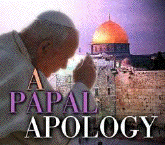
During March 2000 Pope John Paul II made news by
requesting
forgiveness in
the most
significant
confession to
come from the
Vatican. The
Pope publicly
asked
forgiveness
for the
Church's sins
involving
Jews, women,
heretics, and
other
maltreated
groups. He
unequivocally
stated, "We
forgive and we
ask for
forgiveness".
The Holocaust
was not
mentioned nor
were any other
specific
events, but
simply the
acknowledgement
of wrongdoing
was
significant.
http://www.smcm.edu/academics/soan/smp/jewish_resilience/catholic_church_asks_for_forgive.htm
|
Facing the Burden of German History:
Report Details Catholic Role in Nazi Abuses
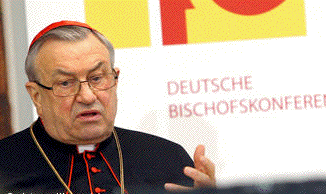
Cardinal
Karl Lehmann
..
|
|
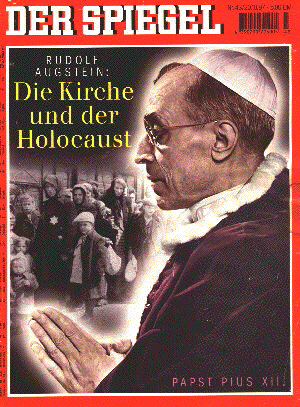
.Pictures from Der Spiegel of October 20,
1997
that Need No
Commentaries:
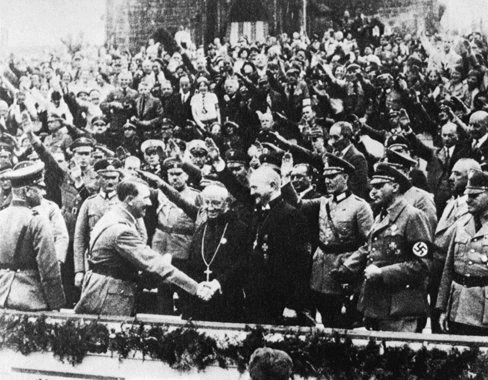
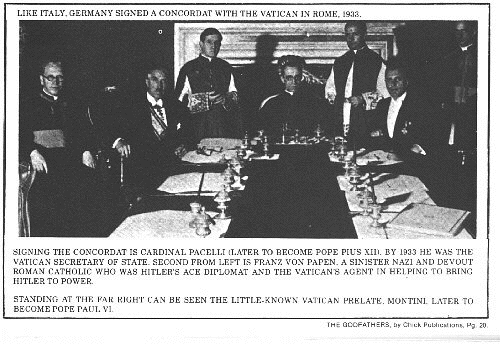
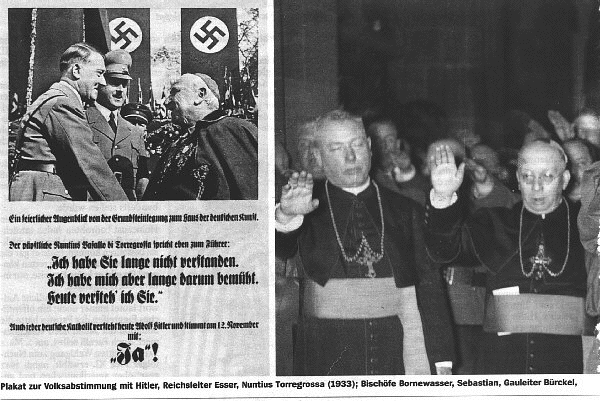
<www.balaams-ass.com/journal/housechu/album.htm>
|
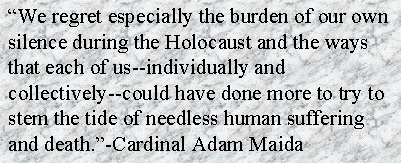
.
|
|

|
|
|
May
God Have Mercy on Their
Silence and Complicity...
Forgive them God, or
Nobody will...
|
.
|
Questioning
the Silence of
God During the
Holocaust
|
- Debating
God and the Holocaust:
Holocaust Survivors in
Search for Faith
-
|
From
Elie Wiesel's
book "Night",
p. 65
|
|
Yom Kippur: The Day of Atonement
|
|
|

|
Should we fast? The
question was
hotly debated.
To fast would
mean a surer,
swifter death.
We fasted here
the whole year
round. The
whole year was
Yom Kippur.
But others
said that we
should fast
simply because
it was
dangerous to
do so. We
should show
God that even
here, in this
enclosed hell,
we were
capable of
singing His
praises.
I
did not fast,
mainly to
please my
father, who
had forbidden
me to do so.
But further,
there was no
longer any
reason why I
should fast. I
no longer
accepted God's
silence. As I
swallowed my
bowl of soup,
I saw in the
gesture an act
of rebellion
and protest
against Him.
And
I nibbled my
crust of
bread.
In
the depths of
my heart, I
felt a great
void.
|
|
|
.http://www.msgr.ca/msgr-8/LENT_holocaust_j.htm
|
.
- An
Analysis of Elie
Wiesel's Relationship
with God
- Faith
in God and Man After
Auschwitz: Theological
Implications
Yad
Vashem -- by Emil L.
Fackenheim
.
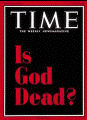
April
8, 1966
|
|
"God
is dead. God
remains dead.
And we have
killed him.
How shall we,
murderers of
all murderers,
console
ourselves?
That which was
the holiest
and mightiest
of all that
the world has
yet possessed
has bled to
death under
our knives.
Who will wipe
this blood off
us? With what
water could we
purify
ourselves?
What festivals
of atonement,
what sacred
games shall we
need to
invent? Is not
the greatness
of this deed
too great for
us? Must we
not ourselves
become gods
simply to be
worthy of it?"
Friedrich
Nietzsche
|
|
|
Rabbi
Richard
Rubenstein:
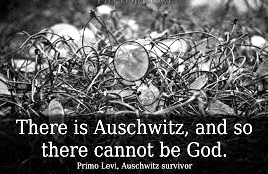
The death of
God occurred
in
Auschwitz...
|
.
|
.
|
5. Other Victims and
Intended Victims of the Nazi Era:
6. A Comprehensive
List of Holocaust Study Sources

- From Yad Vashem:
Basic Bibliography
of the Holocaust

- The Mazal Library:
A HOLOCAUST RESOURCE
- Holocaust Selected
Links
by Holocaust
Institute for Educators of Florida
State University
- Holocaust Links on
the Internet from California State
University
- Holocaust Education
Resources
[From: Centre for
German-Jewish Studies, University of
Sussex at Brighton, UK.]
- Holocaust Study
Resources
- Holocaust Research
Papers
[From the United
States National Archives and Record
Administration]
- Holocaust Pages
- The Holocaust
- Holocaust and
Jewish Studies Sites
by History
Professor Dan Graf of the Virginia
Wesleyan College, USA
- Holocaust Related
Sites
(from the Ghetto's
Fighter House
-- the Holocaust and Jewish Resistance
Heritage Museum, Israel)


- Comprehensive
Internet Links on Holocaust

|
|
R A D O C
|
- Dachau Holocaust
Background Historical Information,
Documents, Photos, and
Bibliographies
by Prof. Harold
Marcuse, University of California,
Santa Barbara, USA
- Shamash's Holocaust
Home Page

- The Holocaust
History Project
- Notable Articles on
the Holocaust
- A Study on The
Poetry of the Holocaust
- Nikki Roth-Skile's
Holocaust/Shoah Resource Page

-

the
world's oldest
Holocaust Memorial
Institution
|
- Holocaust
Translations
- Responses to the
Holocaust: A Hypermedia Sourcebook
for the Humanities
- Historical, Primary
Documents on Holocaust
7. War Crimes and
Holocaust Related Trials:
- Holocaust: the
Evidence of Intent
- A Selection of War
Crimes Trials
Nuremberg Trials,
1945-1949
- An Overview of
the Nurember Trials
- Summary of the
Nuremberg Trials
- The Nuremberg
War Crimes Trials
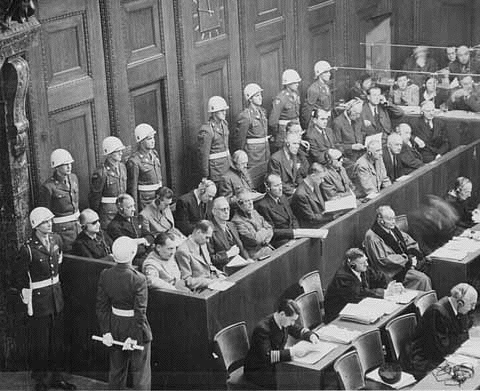
|
|
Defendants
of the Nuremberg
Trial (from
left to right):
|
1st
Row: Hermann
Göring, Rudolf Hess,
Joachim von
Ribbentrop, Wilhelm
Keitel, Ernst
Kaltenbrunner,
Alfred Rosenberg,
Hans Frank, Wilhelm
Frick, Julius
Streicher, Walther
Funk, Hjalmar Schacht.
2nd Row:
Karl Dönitz, Erich
Raeder, Baldur von
Schirach, Fritz
Sauckel, Alfred Jodl,
Franz von Papen,
Arthur Seyss-Inquart,
Albert Speer,
Konstantin van
Neurath, Hans
Fritzsche.
|
|
Photo
Credit:
<perso.wanadoo.fr/d-d.natanson/nuremberg.htm>
|
- The Persecution
of the Jews
- First Hand
Document from Nuremberg Trial
- Witnesses to
Nuremberg
- "Nuremberg --A
Fair Trial? DangerousPrecedent
- Nuremberg
Retrospect
- A Look Back at
Nuremberg
- Photograph of
the Nuremberg Trial
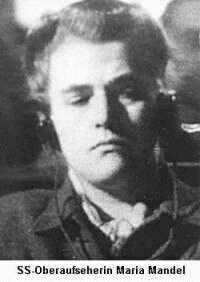
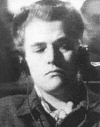 The Infamous SS
Maria Mandel of Auschwitz The Infamous SS
Maria Mandel of Auschwitz
at trial in Poland
|
|
|

|
8. Holocaust Denial
on Trial
9. Post Holocaust
Issues:

- Children
Who Survived the
Holocaust: Reflections
of a Child
Survivor/Psychiatrist
by Robert
Krell, M.D.
- A
Comparison Between
Elderly Holocaust
Survivors and People Who
Survived the Holocaust
as Children
by S.
Robinson, M.D., I. Adler,
Ph.D. and S. Metzer, B.A.
- The
Psychosocial Effects of
the Holocaust on Jewish
Survivors Living in
Poland
by Prof.
Maria Orwid, M.D., Ewa
Domagalska-Kurdziel, M.A.,
Kazimierz Pietruszewski,
M.D.
Cooperation: Ewa Czaplak,
M.A., Ryszard Izdebski,
M.A., Maria Kaminska, M.
Med. Sc.
- Long-Term
Psychological Morbidity
of Incarceration in
Auschwitz
by
Zdzislaw Jan Ryn
- What Do
Holocaust Survivors Feel
Today Toward Their
Perpetrators?
by Shalom
Robinson, M.D., and Sara
Metzer, M.S.W.
|
.
- Overview on
GOVERNMENTS' COMPLICITY IN THE NAZI
HOLOCAUST:
France, Germany, and Switzerland
by Ontario
Consultants on Religious Tolerance
The Role of Swiss
Financial Institutions in the
Plunder of European Jewry
- Turning History
into Justice: Holocaust-Era Assets
Records, Research, and Restitution
(March 1996-March
2001)
- Nazi Gold, Jewish
Accounts, and Swiss Banks
- Holocaust-Era
Assets and the Proper Formula for
Dispensation
- German Companies
Participating in the Forced/Slave
Labor Compensation Fund
-- As of July 2000 --
- Jewish War Claims
in The Netherlands: A Case Study
- Classified Records,
Nazi Collecting, and Looted Art: An
Art Historian's Perspective
[form the United States
National Archives & Records
Administration]
- PBS's Holocaust
"Documentary" Shtetl
- Who Chooses the
Righteous Gentiles?
- The 'Second
Generation' Of Holocaust Survivors
lining up to claim the status of
Holocaust victims
--a controversial
study by the sociologist Frank
Furedi
- How Far? Freedom of
Speech in America: When the Nazis
Came to Skokie, Illinois, USA
|
10.
Myths, Unfounded
Stories, Concocted,
Distorted or Incredulous
Representations of the
Holocaust
|
|
--Exposing
the Untruth, the Bad,
and the Ugly--
|
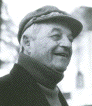
"Get
history right. Respect
the living. Honor the
dead."
Art Abramson,
Executive Director of the
Baltimore Jewish Council
(commenting
on the Holocaust impostor
Deli Strummer)
|
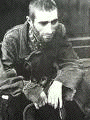
Holocaust Myths
& Facts
- Jews being blamed
by European leaders for
"disproportionate response" to the
Holocaust [sic!]
(As reported by the
New York Times of May 10, 1943)
- On the Question of
Holocaust Victims being made into
Soap
|
Dr. Robert
Rozett, director of the
Yad Veshem's library, when
asked about "human soap"
which was said to have
been manufactured from the
fat of those who were
murdered, Rozett stated
that these were mostly
rumors used by the Nazis
to frighten the inmates.
The INA has discovered
that a Soviet prosecutor
was quoted at length from
an affidavit by Sigmund
Mazur, an Institute
employee, which was
accepted as Nuremberg
exhibit USSR-197. It
alleged that Dr. Rudolf
Spanner, the head of the
Danzig Institute in
Germany, had ordered the
production of soap from
corpses in 1943. A human
soap "recipe," allegedly
prepared by Dr. Spanner
(Nuremberg document
USSR-196), was also
presented. One fact is
known. The Nazis did use
human hair and skin to
make various products.
[israelnewsagency.com/yadvashemholocaustisraelnew88480313.html]
|
|

|
|
|
.
|
|
|
|
|
|
|
|
|
|
- Reflections on a
Holocaust Impostor: Fragments and
Its Tortured History
|
|
A Holocaust
impostor represents yet
another betrayal
--the defrauding of the
Holocaust itself.
|
- Enric Marco,
Purported Spanish Holocaust Survivor
of the Flossenburg Concentration
Camp
Admitted He Has Been Lying for 30
Years...
|
"More than
7,000 Spaniards were sent
to concentration camps,
and most of them died
there...
It's an insult to the
memory of those killed."
Holocaust Survivor Neus
Catala
|
- On the Nazi
Paganism


|
|
Suggestions for further
material to be included in here are
welcome.
|


|
|
Holocaust Remembrance,
Sanctuary, and Beyond ...
|
.
|

 Holocaust Survivors and Remembrance Project: "Forget You Not"™.

 "Forget You Not"™..