August
2, 2006 marks the 61st anniversary of the liquidation of
the so-called Gypsy Family Camp in Auschwitz II-Birkenau,
the Nazi death camp. On that day in 1944, the Nazis
killed 2,897 men, women, and children in the gas
chambers. August 2 has been observed since 1997 as the
Romani
Extermination Remembrance Day.

|
|
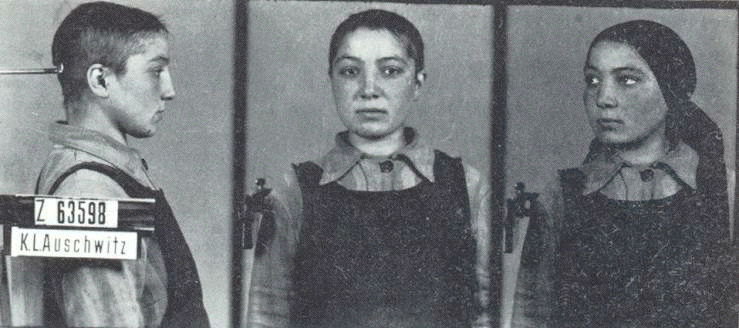
Romani
woman (prisoner no. Z-63598), imprisoned October
1, 1943. The letter 'Z' stands for 'Zigeuner' or
Gypsy. [Auschwitz Memorial
Archives.]
|
In terms of numbers, the Romanies (Gypsies) were the
third-largest group of deportees to Auschwitz, after the
Jews and the non-Jewish Poles. Romani (Gypsy) transports
reached Auschwitz from 14 countries. The first Romanies
arrived on July 9, 1941, when there were two Polish
Romani among a group of nine prisoners sent to the camp
by the German criminal police in Katowice.
In December
1942, the Germans decreed that Romanies (Gypsies) should
be imprisoned in concentration camps. Auschwitz was the
camp chosen. Entire Romani (Gypsy) families were deported
to Auschwitz II-Birkenau. The first transport arrived on
February 26, 1943, when the Familienzigeunerlager
or Zigeunerfamilienlager ("Gypsy Family Camp") was
still under construction; when completed, it comprised 32
residential and 6 sanitation barracks.
|
|
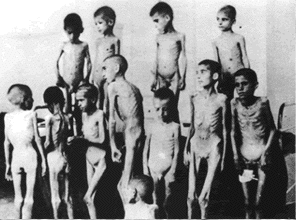
Romani
children, victims of medical experiments at
Auschwitz.
<holocaust.com.au/mm/nonjewish.htm>
|
A total of 20,967 men, women, and children were
imprisoned in the Romani (Gypsy) camp between February
26, 1943 and July 21, 1944. This figure does not include
about 1,700 Romnies from Bialystok,
who were not entered in the records. Suspected of
carrying typhus, they were sent straight to the gas
chambers and exterminated.
Diseases killed
the majority of the nearly twenty thousand prisoners in
the Zigeunerlager. Children deported to or born in
the camp were particularly at risk, with noma ("water
cancer"), scarlet fever, measles, and diphtheria all
endemic. Some children also became subjects of Dr. Josef
Mengele's criminal experiments.
The Germans
intended to exterminate the Romanies completely as early
as May 1944. On May 15, Gypsy Camp director
Unterscharfuehrer SS Georg Bonigut ordered the
inmates to stay in their barracks. The next day, 50 to 60
SS men surrounded the camp. They attempted to force the
prisoners out of the barracks, but failed to do so.
Fearing casualties, the Germans withdrew. There were
significant numbers of Wehrmacht veterans among
the prisoners. The Germans also feared that a mutiny
could spread to other parts of the camp. On May 23, over
1,500 Gypsies were transferred from Birkenau to
Auschwitz, from where they were subsequently transferred
to Buchenwald. Two days later, 82 Gypsies were shipped to
the Flossenburg camp and 144 Gypsy women to Ravensbrueck.
Fewer than 3,000 people remained in the Family
Camp.
The
extermination of the Romanies in Birkenau occurred on the
night of August 2/3, 1944, on orders from Reichsfuehrer
SS Heinrich Himmler. A ban on leaving the barracks was
imposed on the evening of August 2. Despite resistance by
the Gypsies, 2,897 men, women, and children were loaded
on trucks, taken to gas chamber V, and exterminated.
Their bodies were burned in pits next to the
crematorium.
A total of about
23,000 Romanies were imprisoned in Auschwitz-Birkenau;
approximately 21,000 of them perished. The remainder were
transferred to other camps. They labored in industry.
Romanies were also subjected to criminal medical
experiments. They were used as subjects in experiments at
Buchenwald on the effects of drinking sea water.
It is
estimated that about half of the Romanies in lands
occupied by the Third Reich died as a result of German
persecution and terror.
Today, Romanies
remember the murdered members of their families. On
August 2, 1997, two Roma survivors, Herbert Adler (no. Z
2784) and Adolf Labinger (no. Z 41121), unveiled a
restored memorial plaque on the ruins of one of the
Familienzigeunerlager barracks. A permanent
exhibition commemorating the martyrdom of the Gypsies was
opened at the Auschwitz-Birkenau State Museum in
2001.
.
Source:
Auschwitz Memorial Museum and Auschwitz Memorial
Archives.
http://www.auschwitz-muzeum.oswiecim.pl/new/index.php?tryb=news_big&language=EN&id=811

.Special
Selected
Links: