|
..
|
|
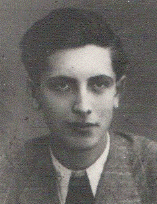
István Katona at 20
|
I was born
István Katona in 1924. My father was the manager of
a large agricultural estate in Kartal, a village of
few thousand people, 40 km from Budapest. We
lived the normal Hungarian assimilated Jewish
existence: I went to Jewish elementary school, had
my Bar Mitzvah, went to the local synagogue on High
holidays. My mother kept a kosher household.
My
father was only 55 years old when he was forcibly
retired in 1942, due to the Hungarian anti-Jewish
laws. The law restricted the number of Jews in
certain professions. The same year, when I just
finished High School, my parents moved to
Tarnaméra, the village where my father was born.
As Jews were not allowed to go to university, I
went to the town of Gyöngyös, where I started an
apprenticeship as an electrical mechanic.
The
Germans occupied Hungary on March 19, 1944, and
imposed a new government. This government, with
German supervision and the enthusiastic
participation of the majority Hungarian
population, brought in daily more and more
restrictions. Jews were not allowed to travel, at
the train station they arrested all Jews, who were
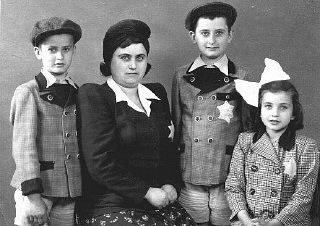
interned and later deported. Within weeks we had
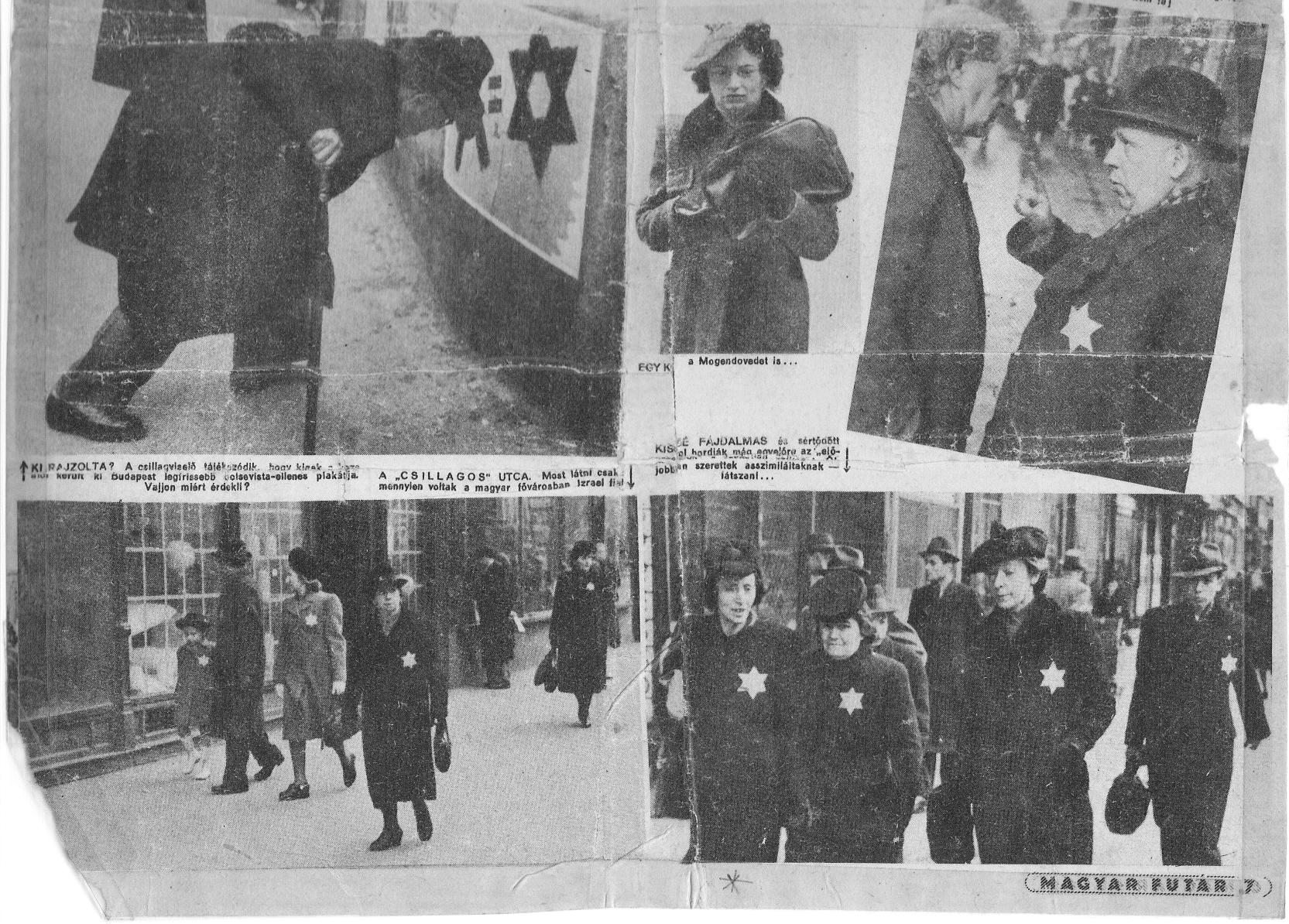
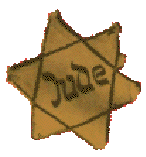
to wear yellow stars. Within six weeks of German
occupation, by the end of April, we had to move
into newly erected ghettoes. At first, these
ghettoes were organized only in the country. In
Budapest at that time they established the so
called "yellow star houses" where the Jews had to
live, and later they had to move to a ghetto too.
The
ghetto was the most horrible, humiliating, soul
destroying experience. My parents had lived a
comfortable, middle class existence. My father was
a proud Hungarian, his eyes were filled with tears
in hearing the Hungarian Anthem and not by hearing
the "Shema Yisroel"
It
was already a shock leaving our home in 1942 and
moving to Tarnaméra, in a small part of our
ancestral home. My father, now without a daily
occupation at 55, felt like a useless homebody.
In
Tarnaméra everybody knew he was a Jew, even
without yellow stars. One felt a Jew, like one is
black haired, has freckles, or limps. It was a
fact, which could not be changed. But to wear a
yellow star, to become a target of ridicule,
shattered my parents.
|
..
|
|
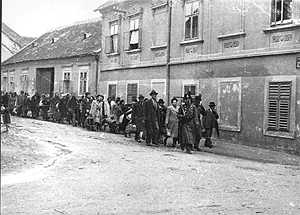
Jews being deported
from Koszeq, Hungary, 1944 [Yad Vashem Archive]
|
On the end of April 1944 the
gendarmerie told us, "be ready, you will be moved
to a ghetto, you are allowed to take 10 kg. of
clothing, cooking utensils etc., but not
valuables, mementos". To us, life ceased to exist.
We were told to hire a horse-drawn carriage, at
our expense, to go to an unknown destination.
In
the first days of May 1944 we were taken to
Bagolyuk, an abandoned mining settlement close to
Eger, approximately 40-50 km away.
What
waited for us was the hell coming to earth.
Hungarian gendarmes and German SS kicked and hit
everybody. They ordered us to get off the
carriage, run to one of the houses, and 2-4
families had to occupy a room. The brutality
dehumanized everybody, not only the ones who did
the beating, but us too. Old friends fought for
the corners of the room, which looked more
comfortable. The same happened in the kitchen,
with cooking and food, if food was available at
all.
For
me personally, the ghetto life did not last long.
First, as a young man I was conscripted to the
ghetto police. Within two weeks came the order
that everybody born in 1924 should go to a forced
labor battalion on the 15th of May, 1944. My
parents were downhearted to be parted from their
only child, but thought --very realistically--
that everything would be better than the ghetto.
How true it was, though I did not know that at
that time.
|
|
|
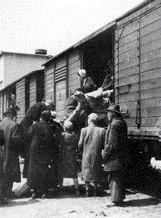
June 15, 1944:
Hungarian Jews deported to Auschwitz
|
|
|
In a late effort to keep control
of the Hungarian Jews, the Horthy regime called up
every Jewish man to labor battalions attached to
the Hungarian Army. My two uncles volunteered and
survived. My father who was a strong practical
man, said to them, "I will not go, somebody has to
stay with the women and children." There were
approximately 15-20 relatives in the ghetto. He
stayed, went with them to Auschwitz, was separated
from them on the first selection, and finally
killed in Dachau.
At
that time, I didn't know what would happen to my
parents. I had the vague idea, that they would
work somewhere to help the war efforts. And in any
case, we had the firm conviction that the war
would not last long and that the Allies would win.
We never thought about the viciousness of the
Germans.
When
every rail carriage was an essential war
necessity, when the Russians had already liberated
half the Ukraine and were already in Romania, they
packed the whole Jewish population from the
Hungarian countryside in cattle cars and deported
them to Auschwitz. It happened to my parents:
their entire ghetto was deported within three
weeks of my departure.
|
..
|
|
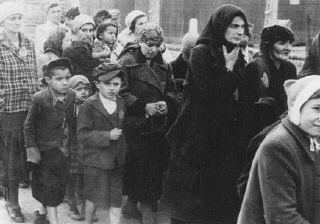
Hungarian Jews on
their way to the gas chambers.
Auschwitz-Birkenau, Poland, May 1944.
[Yad Vashem Photo
Archives]
|
When they arrived in Auschwitz, my
mother made --most probably-- the same selfless,
unwise, lethal decision, that my father made weeks
earlier. At that time, my father did not grab the
last opportunity of going to the labor battalion
"because somebody has to stay with the women." My
mother who was 47 years old, a strong, good
looking healthy country woman, probably said "I
stick to my sisters-in-law, with the small
children" and was sent with them straight to the
gas chamber.
My
father was ordered to the other side and was taken
to Dachau, where according to the very precise,
very complete German documents, he died of "old
age complications" on the 27th of February, 1945.
He
was not even 58!
I
was called up into the labor battalions with all
the boys born in 1924 on the 15th of May, 1944.
Although we were wearing the yellow star, we did
not experience any problem in boarding a train to
Jolsva, in northern Hungary, a part of the country
which had belonged to Czechoslovakia from
1918-1938. It was an exhilarating feeling to sit
in a passenger train carriage and not be kicked,
abused and swore at by all and sundry. We were
assembled randomly, about 300 in one battalion,
and given a group of guards of old Hungarian
peasant soldiers. Our number was 107/302. Our
guards came from the surrounding country side,
which was a lucky break.
The
Czech republic was a real democracy, based on
equality, multiparty system and civil liberties
for all. Our guards lived in that democratic
--although for them alien-- state for twenty
years. They were ethnic Hungarians who first
welcomed the Hungarians back in 1938, but after 6
years of Hungarian rule, they saw the difference.
They
were not harsh to us, in fact our treatment was
mild compared to stories heard elsewhere. We had
to work hard, and they were strict but not cruel.
I
straight away met an old acquaintance, Stephen
Herman. I acquired lifelong friends, like George
Varnai in Sydney, Laci Ivan in France and that
helped. Stephen lived in Spain after the war. We
worked in Ozd in the steel mill, in Putnok in a
timber cutting camp and later, from July, in
Budapest. Here we were housed in a bombed-out
block of flats in Reitter Ferenc Street and worked
in the army food depot, and later in the railway
station, all the time loading and unloading goods
trains. Half of the battalion was from Budapest.
These boys --legally or illegally-- went home to
visit their families on weekends, who by now lived
in the "Jewish houses", and they brought in food,
clothing etc. Even I went out to visit my mother's
aunt, who was my only relative in Budapest.
On
the 15th of October we were standing in line for
lunch. The radio was on and we heard Horthy's
proclamation for asking for peace with the Allies.
We were extremely happy, our freedom has arrived.
Some
of the boys, who worked at the railway station
unloading weapons and ammunitions, got hot under
the collar, commandeered the horse-drawn carriages
of the battalion and went to the railway station
to collect weapons and arm ourselves for the
eventual liberation.
It
took less than six hours for the Arrow Cross
(Hungarian Nazi) Party to take power from the
Horthy regime, with the tacit but forceful help of
the German Occupation Army. Somebody on the street
noticed that we had armed ourselves and reported
us to the police or the Arrow Cross Party.
Police
on trucks arrived and as we had already heard on
the radio, that the Nazis had taken over the
Government, there was a surrender without fight.
The trucks took us to the Police Headquarters. We
stood in the corridor for hours with both hands
held up in the air, facing the wall. Any slackness
was rewarded with a rifle butt in the back. One by
one we were led in and interrogated. When the
police found out who were the "ring leaders" who
brought in the arms, it was about 4 AM. They kept
the "instigators", about 15 men, who, after
further interrogation, were deported to Auschwitz.
The rest of us were escorted back to our quarters.
We were given additional guards, as the Arrow
Cross did not trust our regular army personnel,
who had been with us since May.
Within
two weeks, on the 29th of October, 1944, we were
given marching orders to an unknown destination.
Approximately half of the battalion were Budapest
boys. Most of them deserted, went home or
somewhere in the city, illegally hiding, as they
thought it a better risk for survival. We from the
country had no choice at all, nowhere to go.
The
direction was to the west. We reached the
Hungarian-German [former Austrian] border in less
than a week on foot, [about 200 km]. It was
horrible, our group was now part of a big march.
Our battalion had a fairly good behaved, formerly
Czech citizen "crew," but there were guards
supervising even them, and these guards did not
think twice: anybody who tried to escape, or was
too sick to walk, was summarily shot.
On
the 4th of November, 1944, at the border, they
turned us over to an SS officer, who commanded a
guard outfit of teenagers in the uniform of the
Volksturm, a German auxiliary brigade. Our
sergeant major stood us in line and started to
sing an old Hungarian song "Now anybody should
tell me in my eye, whom I offended in my life
time" [Most mondja el valaki a szemembe, kinek
mit vétettem én életemben]. He started to
cry, because most probably he knew what is waiting
for us.
Contrary
to other people's experience, we were herded to a
passenger train. The doors were locked, a guard
was placed on each connecting platform. We passed
railway stations without stopping, for several
days. One day, we reached the station of a large
city, where lots of German Red Cross ladies were
waiting to give food and water for German troops
going or coming to the Eastern and Western Front.
They could not fathom who we were, the passengers,
so they tried to comfort us. They were rudely
repelled by our guards, but we were a curiosity
for the people on the station, as we had civilian
clothes and were in custody.
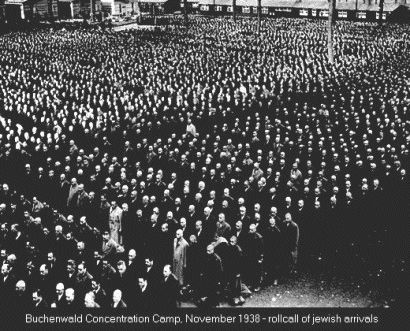 We arrived in
Buchenwald, as we found out later, on the 9th of
November, 1944. At the station funny looking,
striped-clothed people surrounded us, asking in
German and Yiddish to give them all the food and
clothing we have, as the Germans will take away
everything anyway. We did not believe a word they
were saying. How could it happen to us, we were
brought here to work, but anyhow, we are part of
the Hungarian Army.
We arrived in
Buchenwald, as we found out later, on the 9th of
November, 1944. At the station funny looking,
striped-clothed people surrounded us, asking in
German and Yiddish to give them all the food and
clothing we have, as the Germans will take away
everything anyway. We did not believe a word they
were saying. How could it happen to us, we were
brought here to work, but anyhow, we are part of
the Hungarian Army.
Within
minutes we were rudely awakened. We had to strip,
put everything we had down, sent to shower, then
barbers removed any hair [everywhere] we had, and
naked --in November-- marched to pick up the
striped prison clothes and wooden shoes. In a
short time, we looked the same as the "funny
people" in the railway station. We were taken to
an office building, SS guards asked our name, date
of birth, and profession, then they asked, when
were we taken prisoners by the German Army? Some
of us said, that we are not prisoners, we are in
the Hungarian Army. These people were quickly
reminded with a box on the ear or a kick in the
private parts, that what we are, stinking Jews.
Nevertheless in the German files, we were called
"Hungarian Jewish Political Prisoners," as I have
personally seen in records I saw when I went back
to Buchenwald in 1990.
Everybody
was given a number, reminded, that we now had no
names, just numbers, which should be noted and
answered, when called. I became No 87645. My
friend, Laci Ivan, who had an unbelievable
mathematic memory became No 87654. He was
"annoyed" that he received a number, which could
be so easily remembered.
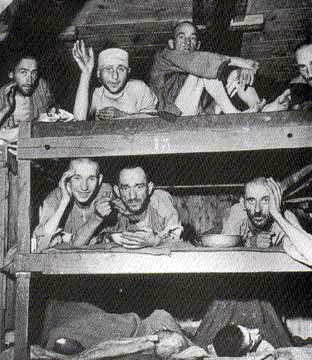
|
..
|
|
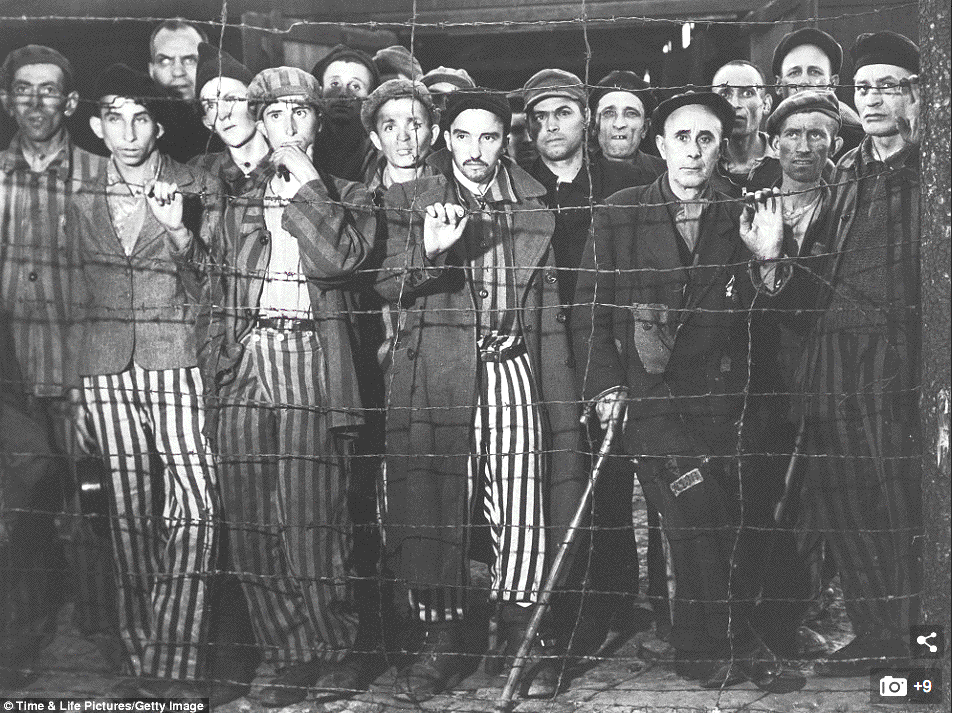
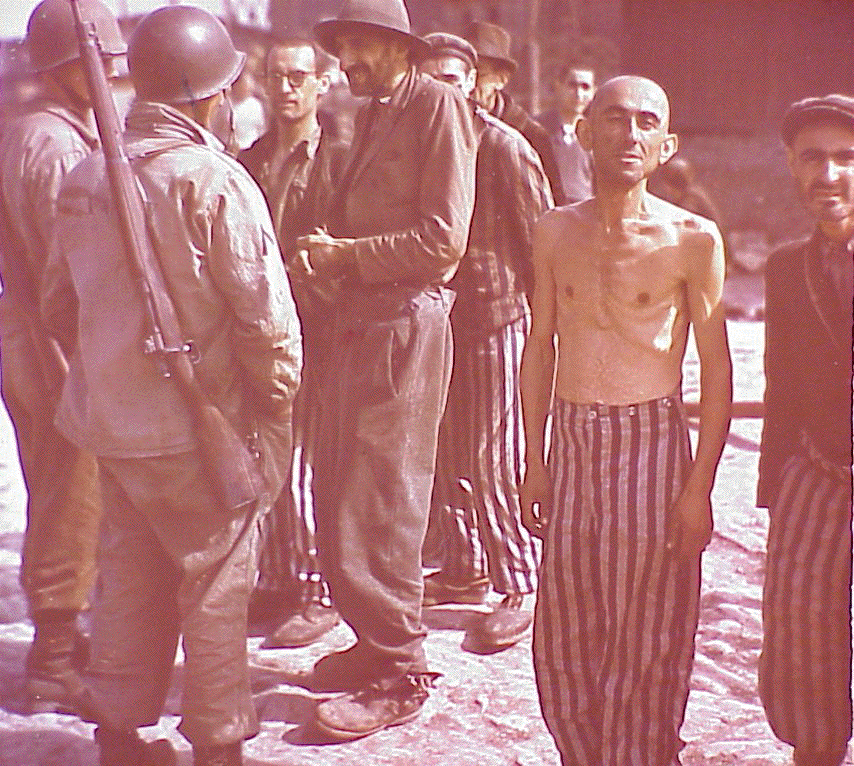
Survivors of
Buchenwald [Yad
Yashem Archives]
|
We were housed in barracks. At the
end of the barracks lived the KAPO, usually a
German common criminal, sometimes a political
prisoner. All were hardened men, with long years
of struggle just to survive behind them. Whoever
survived and became a KAPO, went through lots of
things in the camp, so his life meant more to him
than ours and he behaved accordingly.
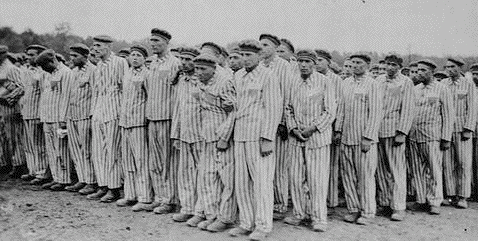
Everybody
had to sew his number on the jacket and a little
triangle, according to classification. Green for
criminals, blue for murderers, red for political,
pink for homosexuals, and yellow for the lowest of
the low, the Jews. The beds were multistory and
two people to a bed. Morning and night we had to
stand for hours on "Appell" (roll call), they
counted and recounted us.
In
the neighboring barrack was the whole Danish
police force, as they had disobeyed the German
order to deport their Jews.
The
food was tea in the morning, soup for lunch and a
piece of bread with a tiny bit of margarine,
sausage or jam [one of these on different days]
for dinner. We were constantly hungry, not knowing
that this is only the beginning.
My
occupation was registered as electrician. A couple
of days later there was a notice on the barracks
board, asking for tradesmen to report in the
office. One of my friends, who was an electrical
instrument repairer, went for "Erdarbeiter" as he
translated this as "farm laborer." But the correct
translation was "construction laborer." He could
not do that job and died shortly.
I
reported for an electrician's job, as did a few
friends from the battalion, who were tradesmen.
One even brought his cousin, hoping he could pass
as an electrical assistant. So we were sent on
November 15, 1944 to SCHLIEBEN to work in an
antitank missile factory [Panzerfaust] I was put
in the electrician's unit, in a separate section
of a barrack. Our KAPO was a Polish political
prisoner with the name of Narczys. I do not think
he ever was an electrician, but a fairly
reasonable man. He covered his back and we had to
work hard, but he was not cruel. We also had a
German electrical foreman, a local electrical
master from the village, who was quite decent.
|
|
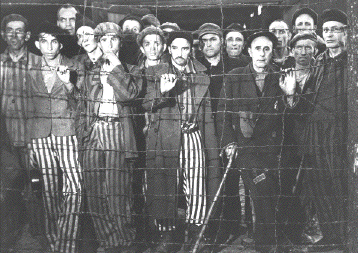
|
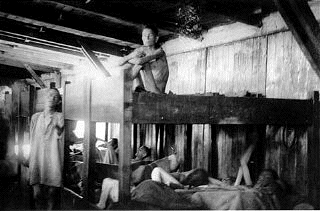
Emaciated male prisoners
of Buchenwald liberated by the
US Army.

|
 Every morning
we had an "Appell" count and marched to the
factory. At night even the dead had to be brought
back, recounted and if the number was not right,
they recounted and recounted again and again for
hours. The guards were extremely cruel. The
favorite pastime was to take off a prisoner's cap
and throw it against the electrified barbed wire
fence. The prisoner was ordered to pick it up.
Then either he was killed by the high voltage of
the fence or shot as a would-be escapee.
Every morning
we had an "Appell" count and marched to the
factory. At night even the dead had to be brought
back, recounted and if the number was not right,
they recounted and recounted again and again for
hours. The guards were extremely cruel. The
favorite pastime was to take off a prisoner's cap
and throw it against the electrified barbed wire
fence. The prisoner was ordered to pick it up.
Then either he was killed by the high voltage of
the fence or shot as a would-be escapee.
One
day --as usual-- I was speaking in Hungarian with
my friend Jancsi Csillag, while working on an
installation. A guard from the tower shouted in
Hungarian "you stinking Jews, work and don't talk"
We found out that he was an ethnic German from
Hungary, who had joined the SS. He was with us
until the liberation. He tried the same "hat
trick" with me one day, jokingly or spitefully, I
don't know. I didn't fall for it and he didn't
force the issue.
As
electricians, we had better food, better quarters
and could move in the camp without guards. The
best job was working in the kitchen. Some piece of
equipment or an appliance went wrong frequently.
We made sure of it. An extra bowl of soup, a piece
of bread that we could obtain, made the difference
between life or death. A favorite was the potato
skin, thrown on the scrap-heap. We collected them,
washed, and baked them on the barrack stove: it
was a veritable feast.
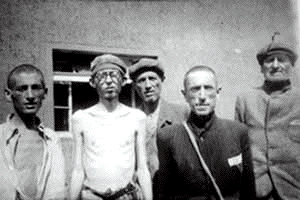
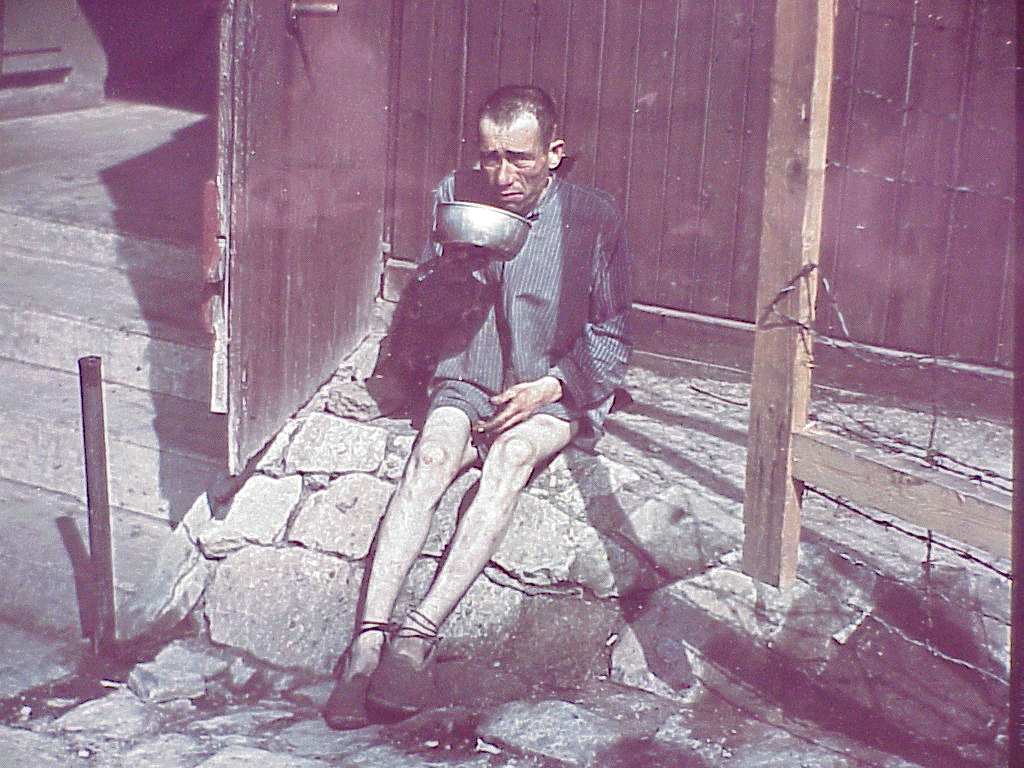
.Buchenwald
Prisoners After the Liberation --
April 12, 1945.
|
|
|
Buchenwald was an
"international" concentration camp
established in 1937 next to Weimar,
Germany. Until the end of March 1945,
approximately 240,000 people from about
30 different countries passed through
Buchenwald and its satellite camps
(about 130 in number). 43,000 of them
were murdered or perished as a direct
result of the harsh camp conditions.
Several thousand more died after the
liberation, from disease and starvation.
[From Yad Vashem Archives]
|
Whoever
gave up, died. A friend of mine was a student of
agriculture, a boxer, a giant of a man. He said on
the first day, that one can not survive treatment
like that, that he is not an animal. He died
within months. Of course it also depended on the
job. The missile had a yellowish substance,
TRINITROTOLUOL as the explosive. It was so
dangerous to the health that even the Germans gave
extra milk for the people who worked with it.
Nevertheless, they died emaciated within a short
time.
Our
life, as Hungarian Jews, was especially hard to
bear among the other, mostly Polish Jewish
prisoners.
There
was an enmity between Hungarians and Poles. The
Poles could not understand why the Hungarians did
not speak Yiddish --which for them was an
everyday, national language. They despised us for
that, for the fact that most Hungarian Jews were
assimilated, thinking of themselves as Hungarians
first, who also had Jewish religious beliefs.
Polish Jews were Jews, not Poles --Jews and
nothing else.
Apart
from cultural differences there was an other
factor, which I could understand but never
condone. They constantly reminded us, that they
had been forced into ghettoes and taken to
concentration camps 4 - 5 years earlier, while we
had lived freely, albeit restricted by "mild"
anti-Jewish laws. The Pole who was in the camp was
a survivor of a bitter struggle just to live, and
wanted to live, even by treating us badly.
I
survived in spite of that constant reminding that
I was a "traitor" who lived well, while they had
suffered.
I
was lucky with my trade, and also I firmly
believed, all the time, without any doubt, that I
would survive, I had to survive.
The
German foreman brought in newspapers, so from that
we knew that the war would not, could not, last
long. So we did everything to survive! My firm
belief in that made me psychologically strong.
There was barely a minute when I doubted that I
would survive.
|
|
|
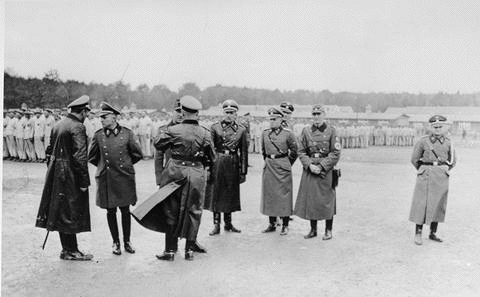
Some of the people in
charge of the Buchenwald Camp
[Courtesy USHMM]
--- +Enlarge
Image
|
The
Camp commander was a German air force officer, who
was wounded in the Eastern front. He was not an
SS, and behaved better than an SS would. In
January 1945, the factory, HUGO SCHNEIDER WERKE,
established an other assembly plant, in FLÖSSBERG.
As they needed electricians, some of us were taken
there. We noticed the difference between the two
camps right away. No paths between the barracks,
just melted snow and unbelievable mud. Everywhere
bodies, where they fell, and left there for days,
just a warning to us. Hungarian Jews were brought
from Budapest in December, to erect --from
nothing-- a camp and factory on the outskirts of
the village.
Within
days our KAPO contacted the commander in
Schlieben, who came around [he was the commandant
of both camps] and told the Flössberg SS to do
something, as the circumstances did not help the
production and the German war effort. He was not
worried about our health, but about the number of
missiles. That was his only concern, but we were
lucky that this helped us too.
Towards
the end of March came my only moment of doubt
about my survival. I was extremely weak with
diarrhea, miserable after the exceptionally cold
1944/45 winter. My left big toe had been
frostbitten since 1941, an extremely hard winter,
when I walked to school, so now it was inflamed
enormously. Accidentally I hit my thumb on my left
hand with a hammer, and it become infected, with
an inflamed lymph node under my left arm. I went
to the camp hospital and asked time off from work.
|

|
..
|
Children and youths
are being led in columns by soldiers
of the 3rd US Army to a hospital sick
bay after the liberation of the
Buchenwald concentration camp in
Buchenwald, Germany, April 13,
1945.
|
|
|
There was a Hungarian doctor, who
told me, that he would not do that, as anyone
unable to work will be sent back to Buchenwald, to
an uncertain fate, indicating death. But, he said,
he needs an electrician in the hospital, so I
could be a hospital orderly, sleep in my own
corner in the storeroom, and have a bit better
food. It was my lucky break, I even could help my
friends, like George Varnai, who was at that time
in the hospital (later on he was shipped back to
Buchenwald, but it was the last days of the war,
so he survived).
In that hospital, I received my first and lifelong
lasting lecture about Communism. There was a
Russian doctor, a political prisoner of war, so he
could work only as an orderly. He said that when
war ended, the Soviet Union would dominate the
whole of Eastern Europe and Hungary would be a
colony! But --he said-- do not hope for much: the
whole middle class, the rich peasants, would all
be liquidated [he explained, how it was done in
the Soviet] and in any case, Jews are incapable to
become good Communists, as they are socially,
morally and by their tradition not suited to it.
So it seemed that for me, there was no future, as
I had so many bad points.
On
the 13th of April 1945, we were already hearing
Allied tanks roaring, and seeing flares up in the
night sky. Then a trainload of cattle wagons were
brought in the camp, everybody was packed in, and
we started our journey.
There
was 3 more weeks of misery for us, even they could
have easily left us there and saved their own
hides. But it was more important for the SS to
make sure that we would perish. As I found out in
1992, when we went to Flössberg for a visit, the
Americans arrived in the village one day later,
the 14th of April.
|
..
|
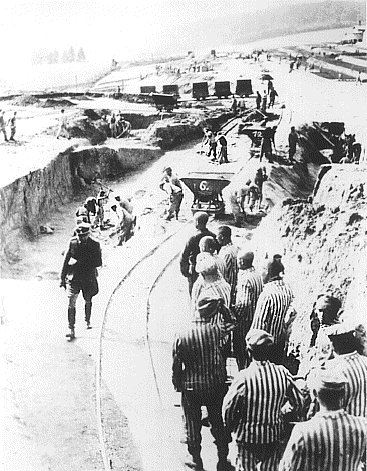
Prisoners are forced
to build the "Russian Camp" in
Mauthausen, Austria in 1942.
[Photo credit: USHMM
Photo Archives}
|
|

|
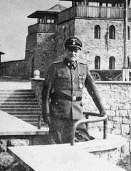
Franz Ziereis,
Commandant of Mauthausen from August
1939 to May 1945. [Andras
Tsagatakis Photo Collection, courtesy of
USHMM]
|
|
We
were on the train for about two weeks, taken
through Germany and Czechoslovakia and finally to
MAUTHAUSEN.
I
do not know how I or anybody else survived the
train trip as we seldom if ever had anything to
eat. I have only a very vague recollection about
the journey. The only thing I remember that from
time to time the train stopped in the middle of
nowhere, we were let out, to throw down the dead
bodies. I definitely remember looking for
charcoal, as everybody had diarrhea and that was
the only "medicine" available. Finally, we walked
from Mauthausen train station to the camp, on the
top of the mountain.
My
spirit rose, when the Hungarian speaking SS --from
our old camp-- came alongside me and said. "It
will be all right now for you, the war will not
last longer than a few days, but what will happen
to me?" I did not dare to tell him, what I
thought, that he deserved what he will get [or is
he today a wealthy businessman in Germany?]
In
the camp, it was the usual procedure, never mind
that the war was close to the end. Shower,
delousing, back to the same dirty uniform, march
down to the so called "Russenlager" a section of
the camp, which earlier housed Russian POWs, but
now was the place to collect deportees to die from
"natural causes". Within days the SS disappeared,
and the camp was taken over by Viennese police. On
the 5th of May, 1945, the Americans arrived, not
believing what they saw.
There
were rotting bodies everywhere, and for days the
Americans wandered around, filming the scenes from
Dante's inferno. They forced the town folk to see
the camp, then to dig mass graves, where German
soldiers and locals had to bury the victims with
their bare hands.
|
..
|
|
|
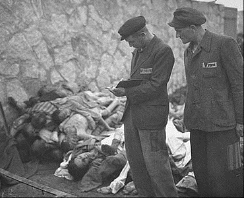
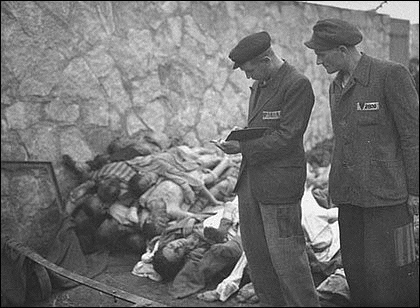
Survivors count the
corpses of prisoners killed in the
Mauthausen concentration camp. [Source:
U. S. National Archives, College
Park, Maryland]
|
|

|
The Americans wanted to be
helpful, so they gave us food. Lots of people died
in the next weeks from over-eating. People who
were feeble, sick, hungry, ate the --rich and
plentiful food and died. Laci Kantor, who days ago
had kissed me, and thanked God that he had
survived, that he was free to go home to his
parents, laid in our bed next morning, dead by my
side.
Slowly
the Americans realized the situation and erected
tents for hospitals and took the sick there. Every
hour a little bus arrived, picking up 12 people,
who were laid out in front of our barrack, waiting
for the transport to the hospital. My instinct for
life gave me strength to crawl out on my own
accord, and lay beside them. The hospital bus
came, there were 13 people. What could they do?
They took 12, and would come back for the 13th an
hour later. I was among the 12. Who knows, maybe
this hour made the difference between life and
death. I knew I had to do it.
|
|
|
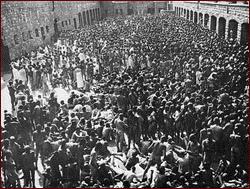
Six thousand (6000)
inmates await disinfection in a
Mauthausen courtyard, July 1941. After
24 hours of waiting, nearly 140 had
died. [PBS, USA]
|
|
|
I
received blood and sugar transfusion and in two
weeks I was up in the main camp, ready to be
repatriated.
All
nationalities were separated for transport, so my
friend from Northern Hungary, János Csillag,
became again a Czech citizen, to return to
Nove-Zamky, [Érsekujvár].
The
Jews from Transylvania, in 1944 a Hungarian
territory, had a problem [Transylvania, in
Hungarian Erdély, was taken in 1920 by the Trianon
Treaty from Hungary and became a Romanian
territory. Hitler gave it back in 1940 to the
Hungarians]. They wrote to King Michael, to send a
train for them. The King replied, that it must be
a mistake, they must be Hungarians, as Jews were
not deported from Romania, so why don't they go
back to Hungary. It was the way he paid back to
the Transylvanian Jews, who always regarded
themselves Hungarians, even under Romanian rule,
between 1918-1940.
Our
transport back to Hungary started on the June 1,
1945. Mauthausen was in the American zone of
occupation. The border of the Soviet zone was at
Linz, where we changed trains. The first
impressions of a Russian soldier was not
flattering. They were dirty, hungry, and nearly
always drunk. In the afternoon in Vienna we had to
cross a bridge --bombed in the Danube-- on foot.
Everybody had to show his left armpit, for the
tell-tale sign of the SS tattoo of the blood
group. My left armpit was swollen, puss oozing for
the last 3-4 months. I had an infection after
hitting my left thumb with a hammer, losing my
thumb-nail. So the Russian soldier said I must be
an SS, who tried to get rid of his tattoo. To make
it worse, I was wearing a stripped down German
uniform, given to me by the Americans. The boys
traveling with me told him in several languages,
no, not SS, Jewish, Konzentrationslager, but to no
avail. He locked us [as everybody very valiantly
stayed with me] into a shed, saying that the
commandant will decide our fate in the morning.
During
the night, there was a knock on the wall. An
Austrian man asked us, why were we locked in. We
told him, that one of us is a suspected SS,
wrongly accused. He broke the wall of the shed and
lead us through the gardens to the street, where
we reached the sector occupied by the Western
Allies. Who knows, was it his good heart, or did
he want to help an SS?
|
..
|
|
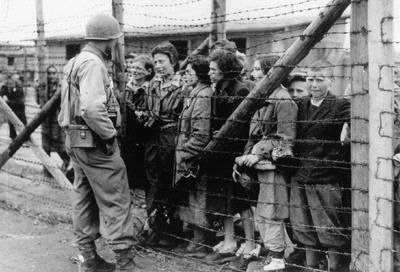
Mauthausen at
liberation by the US troups [United
Staes Photo Archives]
|
|
|
Next day we went by train to
Hungary. I did not go further than Szombathely, a
border town, where the Hungarian medics put me in
hospital. I had three weeks of freedom since
liberation, weighed 35 kg., with my 183 cm height.
I was operated on my armpit, received antibiotics,
and good nourishing food.
When
they felt I was well enough, around the middle of
July, I went to Budapest, where I knew I had my
mother's aunt. The train travel was a nightmare.
People stormed the train in the second it pulled
in the station. Thousands traveled, mostly for
scrounging for food, as Budapest, 6 months after
liberation, was a city of starved people, totally
without affordable food supply. There was a
rampant inflation, one's wages was not worth a
kilogram of bread at the evening of a pay-day.
People sat even on the roof of train carriages,
just to get somewhere, somehow.
My
reaction from the concentration camp was, that I
could not conceive anything funny. I spent 10-14
days in Budapest before going to Tarnaméra. One
day I went to see a Charlie Chaplin movie. The
audience roared with laughter about the
misfortunes of the little man. I could not
understand why they laughed. I just felt sorry for
him. So I walked out in the middle of the
screening.
When
I reached Tarnaméra, I realized that I arrived
back to a forgotten existence that I had left just
15 months ago. Those months were eradicated from
my life, when I became a non-person in a near to
animal existence, from October 1944 to May 1945.
Nobody
recognized me, not a living soul, but one.
When
we left to the ghetto, we gave our little
fox-terrier to a neighbor. The dog was on the
street, came towards me, licked my trousers,
sniffed and jumped up and down. I became myself
again, who, at last, been recognized and loved
--by a dog.
Our
tenant seemed glad to see me, and told to go to
the police station, where my friend Alex Seidner
(now in Melbourne) was the local chief. He was the
first Jew, who returned to Tarnaméra in the early
spring of 1945, so he became the police sergeant.
I slept in a bed, washed myself, ate and tried to
become a normal person.
It
sank in slowly, that I would not see my parents
again. Even in the summer of 1944, we thought that
they would be taken away from the ghetto to work.
Some people even received a postcard, from a
mysterious WALDSEE, somewhere near to Switzerland
on the map.
I
did not receive any, but I did not get very
worried. In the concentration camp we saw men,
women, but no children or old people. But the
daily struggle, just to survive, blunted our
senses. It was not selfishness, that we did not
think about anything not connected with our daily
survival, it was pure animal behavior. The Nazis
did not think, that we were better than an animal,
so by their treatment we became one.
In
the next months, after inquiries, I found out that
apart from me, only two uncles and two cousins
survived from the whole family. The family
consisted of: 1 grandfather, 2 parents, 19 uncles
and aunts and 19 cousins. So 5 of us were left out
of 41 persons! 36 murdered by gas, by beating,
overwork, or starvation. Nobody will ever know the
exact truth about how they died.

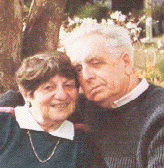
|
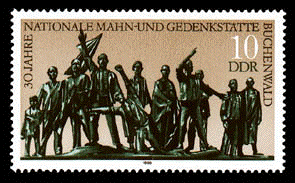
We've come a long
way ...
Agi & Stephen Casey
|

|
|
PS. For those that are
interested to have a glimpse into the
Jewish life of a small town in Hungary
prior to the Holocaust, please see a
pamphlet written by a retired Catholic
High School teacher from
Sàtoraljaujhely, a town in
North-Eastern Hungary, that was
translated from Hungarian by Mr. Casey
and his wife Agi. The document can be
downloaded by clicking on the 1st
button at left. Also Agi and Stephen
Casey have translated from Hungarian
the story of a Jewish school
established in the early 1800's in the
same town. To see that story, please
click on the last button at left.
(If you do not have
the Adobe Acrobat Reader for reading a
PDF file, then please click on the
middle button at left to get a free
copy of the program.)
|

|
|
.





-doc.GIF)