Holocaust Survivors and Remembrance Network
preserving the past to protect the future ...

.

Khaled Abdelwahhab of Tunisia
First Arab Nominated for the "Righteous Among the Nations" Holocaust Honor
.
 

By MATTI FRIEDMAN
Associated Press

January 30, 2007


JERUSALEM - At the height of World War II, Khaled Abdelwahhab hid a group of Jews on his farm in a small Tunisian town, saving them from the Nazi troops occupying the North African nation.

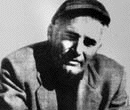
Khaled Abdelwahhab


In this undated handout photo released on Jan. 30, 2007, Tunisian Arab Khaled Abdelwahhab is seen at an unknown location. At the height of the Second World War, Khaled Abdelwahhab hid a group of Jews on his farm in a small Tunisian town, saving them from the Nazi troops occupying the north African nation. More than six decades later, Abdelwahhab has become the first Arab nominated for recognition as "Righteous Among the Nations" by Yad Vashem, Israel's official Holocaust memorial. The honor is bestowed on non-Jews who risked their lives to save Jews from Nazi persecution. (AP Photo/HO)

Now, Abdelwahhab has become the first Arab nominated for recognition as "Righteous Among the Nations," an honor bestowed on non-Jews who risked their lives to save Jews from Nazi persecution.

The nomination of Abdelwahhab, who died in 1997, has reopened a little-known chapter of the Holocaust in the Arab countries of North Africa.

Abdelwahhab was nominated by Robert Satloff, director of the Washington Institute for Near East Policy, a U.S. think tank.

Satloff said that after the Sept. 11 attacks, he went to Morocco to research what happened during the Nazi genocide in hopes of countering Holocaust denial in the Arab world and tempering some of the sentiments he thought helped pave the way for the attacks.

"I asked, did any Arabs save Jews in the Holocaust?" Satloff said. "If they did, these are stories about which Arabs could be proud. It would also entail accepting the context, because it would mean there was something to save Jews from."

The search led to Abdelwahhab, the son of an aristocratic family who was 32 when German troops arrived in Tunisia in November 1942. The nation was home to some 100,000 Jews at the time.

According to Israel's Holocaust memorial, Yad Vashem, the Germans imposed anti-Semitic policies in Tunisia that included fines, forcing Jews to wear Star of David badges and confiscating property. More than 5,000 Jews were sent to forced labor camps, where 46 are known to have died. About 160 Tunisian Jews in France were sent to European death camps.

Abdelwahhab served as an interlocutor between the population of the coastal town of Mahdia and German forces, Satloff said.

When he heard that German officers were planning to rape Odette Boukris, a local Jewish woman, he gathered her family and several other Jewish families in Mahdia - around two dozen people - and took them to his farm outside town. He hid them for four months, until the occupation ended.

"Khaled is the finest example, though not the only one, of an Arab who saved Jews from persecution during the German occupation," Satloff said.

Satloff first heard Abdelwahhab's story several years ago from Odette Boukris' daughter, Anny Boukris, a resident of a Los Angeles suburb. An 11-year-old in 1943, Anny Boukris was also hidden by Abdelwahhab.

Satloff went to Mahdia and talked to Anny Boukris' childhood friends, who confirmed the story. Just weeks after Boukris recorded her 83-page testimony, she died at age 71.

Abdelwahhab still has to be approved by the Yad Vashem commission that grants the honor. Since the war, Yad Vashem has conferred the status on 21,700 people, including some 60 Muslims from the Balkans. But no Arab had ever been nominated.

"The commission will decide based on the strict criteria for recognizing the Righteous Among the Nations. We can't speculate on what the outcome will be," said Estee Yaari, a spokeswoman for Yad Vashem.

Tunisia was the only North African country to come under direct Nazi rule. Morocco and Algeria were governed by the pro-Nazi collaborators of Vichy France.

Bruce Maddy-Weitzman, a North Africa expert at Tel Aviv University, said Morocco's king at the time, Mohammed V, intervened to protect Jews in his country. "But the story in Tunisia was quite different, because there was a direct occupation by the German army," he said.


.

http://tledit.us.publicus.com/article/20070130/API/701302745

.

Tunisian set to be 'Righteous Gentile'
Landowner gave families sanctuary

.


by David Sharrock in Jerusalem


An Arab who saved the lives of two dozen Jews during the Holocaust is about to receive an unprecedented honour from Israel. Khaled Abdelwahhab, a wealthy Tunisian landowner, is poised to become the first Arab to be celebrated as a Righteous Gentile.

The award, presented by Yad Vashem, the Holocaust remembrance authority, is granted to non-Jews who risked their lives to save Jews during the Holocaust in which six million died.

More than 21,000 people have been granted the title of Righteous Among the Nations since it was established in 1963, with Oskar Schindler probably the best known. But, in spite of stories of heroism and friendship recorded by members of North Africa's once-large Jewish community, no candidate has emerged from the Arab Muslim world.

The story of Khaled Abdelwahhab was uncovered by an American Jewish expert on Arab and Islamic politics who was researching for a book.

A survivor told Robert Satloff that Abdelwahhab had rescued 23 Jews, including her family, as they sheltered in an olive oil factory after being thrown out of their homes by German soldiers. He feared that the women were going to be put to work in a brothel and gave them sanctuary for the remaining six months of the German occupation.

Interviewed at her home in Los Angeles a few weeks before her death, Anny Boukris said that Abdelwahhab had discovered that German officers were planning to take her mother, Odette, to work in the brothel they had set up in Mahdia, on the east coast of Tunisia.

Abdelwahhab's father was a good friend of the Boukris family, so he drove straight to the olive oil factory and told all the Jews sheltering there that their lives were in danger and that they must go with him immediately.

He settled them all at his family farm in the village of Tlelsa, 20 miles from Mahdia, and they remained there until British troops ended the German occupation in April 1943.

Abdelwahhab was 32 when the Germans arrived in Tunisia and was described by Dr Satloff as a bon vivant, blessed with Hollywood film-star looks &emdash; and an eye for the ladies. His father was a former minister to the court of the Tunisian bey [sovereign].

Abdelwahhab studied art and architecture in New York and lived for a time in Paris. He married a Venezuelan opera singer in Spain and she became the mother of one of his two daughters. He died in 1997 at the age of 86.

Estee Yaari, of Yad Vashem, told The Times that a file on Abdelwahhab had been opened and would be considered by a commission of experts led by a supreme court judge. "It looks as if there is enough material to move this forward and he would be the first Arab to become a Righteous Among the Nations," she said.

Dr Satloff, executive director of the Institute for Near East studies in Washington, uncovered the story of Abdelwahhab's heroism while working on a book that he hoped would break "the conspiracy of silence" in the Arab world surrounding the rescue of Jews during the Holocaust.

Dr Satloff, who flew to Israel to meet Yad Vashem officials yesterday, said: "These stories are only coming to light now because we haven't looked too hard before at the Holocaust experience in Arab countries. But another reason is that Arabs who did save Jews didn't want to be found. They are reluctant to admit that they saved Jews."

More than 1.5 million Jews lived in northern Africa during the Second World War and were subject to persecution by the Nazis and their allies there, although few were sent to the death camps in Europe.

.

http://www.timesonline.co.uk/article/0,,3-2562887,00.html