|
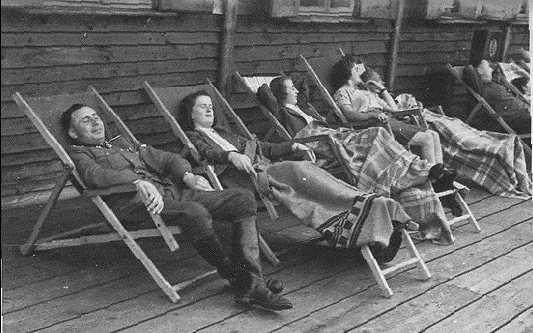
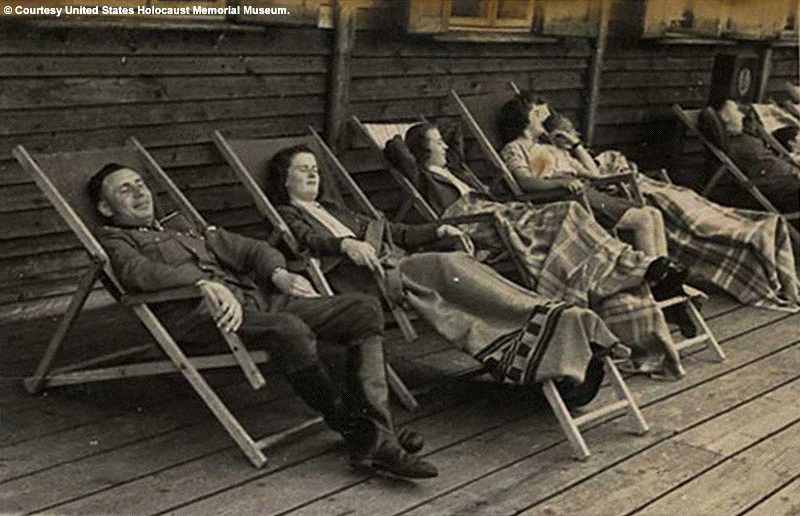
.Between
savagery and killings, savouring the simple
pleasures of life:
Karl
Höcker, adjutant to the
commandant of Auschwitz, and SS auxiliaries
relaxing at a recreation lodge near the camp.

WASHINGTON,
Sept. 18, 2007 -- Last December, Rebecca
Erbelding, a young archivist at the United
States Holocaust Memorial Museum, opened a
letter from a former United States Army
intelligence officer who said he wanted to
donate photographs of Auschwitz he had found
more than 60 years ago in Germany.
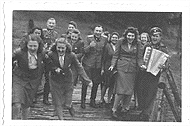
Life is good at
Auschwitz:
The SS guards making time to enjoy
life.
|
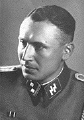
Karl Höcker
|
Ms. Erbelding was intrigued: Although Auschwitz may be the most
notorious of the Nazi death camps, there are
only a small number of known photos of the
place before its liberation in 1945. Some time
the next month, the museum received a package
containing 16 cardboard pages, with photos
pasted on both sides, and their significance
quickly became apparent.
As Ms.
Erbelding and other archivists reviewed the
album, they realized they had a scrapbook of
sorts of the lives of Auschwitz's senior SS
officers that was maintained by Karl Höcker, the adjutant to
the camp commandant. Rather than showing the
men performing their death camp duties, the
photos depicted, among other things, a horde
of SS men singing cheerily to the
accompaniment of an accordionist, Höcker
lighting the camp's Christmas tree, a cadre of
young SS women frolicking and officers
relaxing, some with tunics shed, for a smoking
break.
In all there
are 116 pictures, beginning with a photo from
June 21, 1944, of Höcker and the commandant of
the camp, Richard Baer, both in full SS
regalia. The album also contains eight photos
of Josef Mengele, the camp doctor
notorious for participating in the selections
of arriving prisoners and bizarre and cruel
medical experiments. These are the first
authenticated pictures of Mengele at
Auschwitz, officials at the Holocaust museum
said.
The photos
provide a stunning counterpoint to what up
until now has been the only major source of
preliberation Auschwitz photos, the so-called
Auschwitz Album, a compilation of pictures
taken by SS photographers in the spring of
1944 and discovered by a survivor in another
camp. Those photos depict the arrival at the
camp of a transport of Hungarian Jews, who at
the time made up the last remaining sizable
Jewish community in Europe. The Auschwitz
Album, owned by Yad Vashem, the Israeli
Holocaust museum, depicts the railside
selection process at Birkenau, the area where
trains arrived at the camp, as SS men herded
new prisoners into lines.
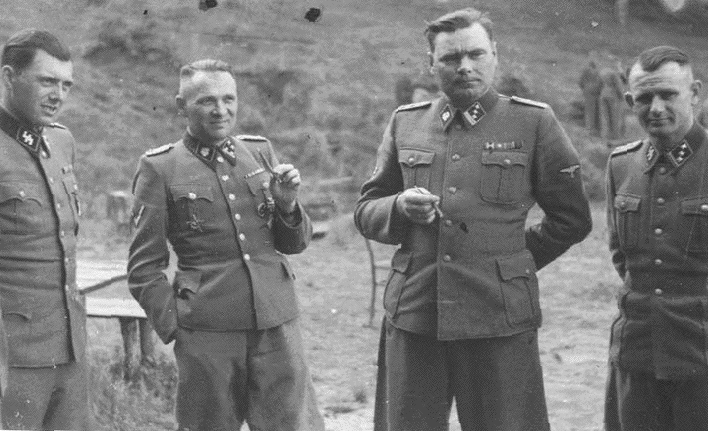
.Left to
right: Dr. Josef Mengele, Rudolf Höss, Josef
Kramer, and an unidentified officer.
[United States Holocaust Memorial Museum #34755]

|
.Members
of the "Master Race" relax at their
retreat at Solahutte outside of
Auschwitz.
From left: Richard Baer,
who became the commandant of Auschwitz
in May 1944;
Dr. Josef Mengele; Josef
Kramer (hidden), Commandant of
Auschwitz-Birkenau; and,
Rudolf Hoess (foreground), the former
Commandant of Auschwitz; with the man
at right unidentified.
|
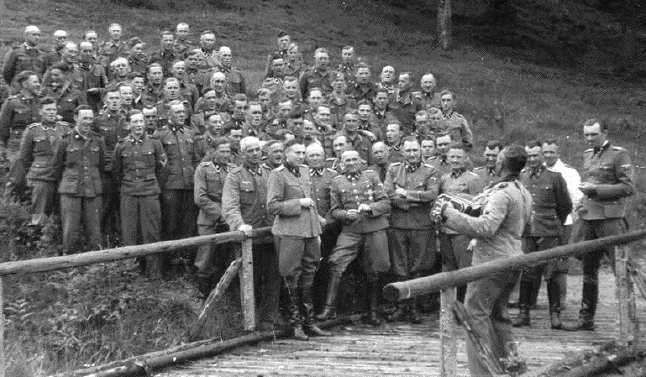
.Taking a
break from savagery and killings, SS Officers
are in the mood to sing:
An accordionist leads a sing-along
for SS officers at their retreat at Solahutte
outside Auschwitz.
Pictured in the front row are Karl Hoecker, Otto
Moll, Rudolf Hoess, Richard Baer, Josef Karmer,
Franz Hoessler, and Dr. Josef Mengele.
[United States Holocaust Memorial Museum]
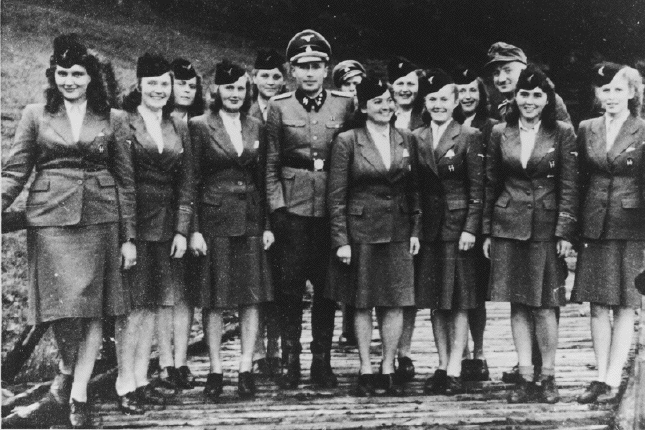
.All
smiles:
Members of the SS
Helferinnen (female auxiliaries) arrive in
Solahuette, the SS retreat near Auschwitz.
(Karl Hoecker is standing in the center.)
[United States Holocaust Memorial
Museum #34762]]
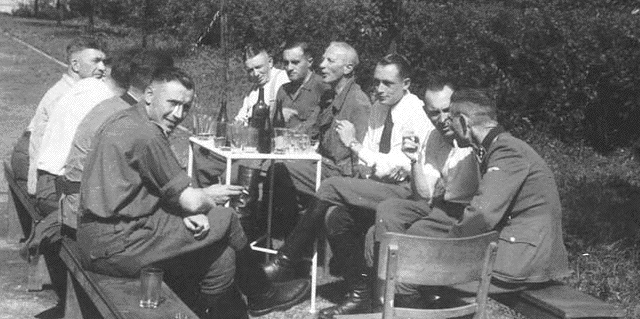
.Karl
Höcker (on left, looking at the camera) relaxes
with SS physicians,
including Dr. Fritz Klein (far left), Dr. Horst
Schumann (partially obscured next to Klein,
identified from other photographs),
and Dr.
Eduard Wirths (third from right,
wearing tie).
[United States Holocaust Memorial
Museum #34797]
The comparisons
between the albums are both poignant and
obvious, as they juxtapose the comfortable daily
lives of the guards with the horrific reality
within the camp, where thousands were starving
and 1.1 million died.
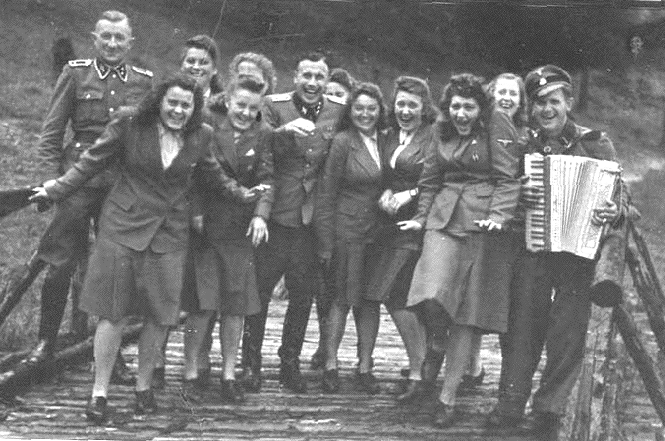
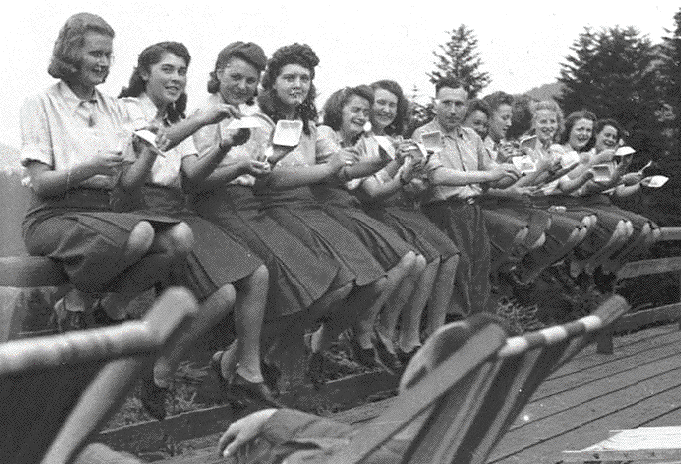
Life is good at Auschwitz: All smiles.
The SS female auxiliaries (Helferinnen) show
with mock sadness that they have finished eating
their blueberries, July 22, 1944.
[United States Holocaust Memorial
Museum #34769]
For example,
one of the Höcker pictures, shot on July 22,
1944, shows a group of cheerful young women
who worked as SS communications specialists
eating bowls of fresh blueberries. One turns
her bowl upside down and makes a mock frown
because she has finished her portion.
On that day,
said Judith Cohen, a historian at the
Holocaust museum in Washington, 150 new
prisoners arrived at the Birkenau site. Of
that group, 21 men and 12 women were selected
for work, the rest transported immediately to
the gas chambers.
Those killings
were part of the final frenetic efforts of the
Nazis to eliminate the Jews of Europe and
others deemed undesirable as the war neared
its end. That summer the crematoriums broke
down from overuse and some bodies had to be
burned in open pits. A separate but small
group of known preliberation photos were taken
clandestinely of those burnings.
Auschwitz was
abandoned and evacuated on Jan. 18, 1945, and
liberated by Soviet forces on Jan. 27. Many of
the Höcker photos were taken at Solahütte, an
Alpine-style recreation lodge the SS used on
the far reaches of the camp complex alongside
the Sola River.
Though they as
yet have no plans to exhibit the Höcker album
photos, curators at the Holocaust Memorial
Museum have created an online display of them
on the museum's Web site (ushmm.org) that will
be available this week. In many cases they
have contrasted the Höcker images with those
from the Auschwitz Album. In one, SS women
alight from a bus at Solahütte for a day of
recreation; meanwhile, in a picture from the
Auschwitz Album taken at about the same time,
haggard and travel-weary women and children
get off a cattle car at the camp.
Museum
curators have avoided describing the album as
something like "monsters at play" or "killers
at their leisure." Ms. Cohen said the photos
were instructive in that they showed the
murderers were, in some sense, people who also
behaved as ordinary human beings. "In their
self-image, they were good men, good comrades,
even civilized," she said.
Sarah J.
Bloomfield, the museum's director, said she
believed that other undiscovered caches of
photos or documents concerning the Holocaust
existed in attics and might soon be lost to
history.
The donor, who
had asked to remain anonymous, was in his 90s
when he contacted the museum, and he died this
summer. He told the museum's curators that he
found the photo album in a Frankfurt apartment
where he lived in 1946.
The photos of
the Auschwitz Album were discovered by Lili
Jacob, a Hungarian Jew who was deported in May
1944 to Auschwitz, near Krakow in Poland. She
was transferred to another camp,
Dora-Mittelbau in Germany, where she
discovered the pictures in a bedside table in
an abandoned SS barracks.
She was
stunned to recognize pictures of herself, her
rabbi and her brothers aged 9 and 11, both of
whom she later discovered had been gassed
immediately after arrival.
Höcker fled
Auschwitz before the camp's liberation. When
he was captured by the British he was carrying
false documents identifying him as a combat
soldier. After the 1961 trial of Adolf
Eichmann in Israel, West German authorities
tracked down Höcker in Engershausen, his
hometown, where he was working as a bank
official.
He was
convicted of war crimes and served seven years
before his release in 1970, after which he was
rehired by the bank. Höcker died in 2000 at
89.

Copyright
2007 The New York Times Company
|
|