|
.
|
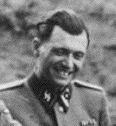
.Dr. Mengele
relaxing at Solahutte
retreat outside of Auschwitz.
|
The notorious
doctor of Auschwitz, Josef Mengele, has become an
enigma of the twentieth century. Mengele's handsome
physical appearance, fastidious dress, and calm
demeanor greatly contradicted his attraction to murder
and gruesome experiments.
Mengele's
seeming omnipresence at the ramp as well as his
fascination with twins have incited images of a mad,
evil monster. His ability to elude capture had
increased his notoriety as well as given him a
mystical and devious persona.
But in May
1943, Mengele entered Auschwitz as an educated,
experienced, medical researcher. With funding for
his experiments, he worked alongside some of the top
medical researchers of the time. Anxious to make a
name for himself, Mengele searched for the secrets
of heredity. The Nazi ideal of the future would
benefit from the help of genetics: if Aryan women
could assuredly give birth to twins who were sure to
be blond and blue eyed - then the future could be
saved.
Mengele, as he
learned while working for Professor Otmar Freiherr
von Vershuer, believed that twins held these
secrets. Auschwitz seemed the best location for such
research because of the large number of available
twins to use as specimens.
The
Ramp
Mengele took
his turn as the selector on the ramp, but unlike
most of the other selectors, he arrived sober. With
a small flick of his finger or riding crop, a person
would either be sent to the left or to the right, to
the gas chamber or to hard labor. Mengele would get
very excited when finding twins. The other SS who
helped unload the transports had been given special
instructions to find twins, dwarfs, giants, or
anyone else with a unique hereditary trait like a
club foot or heterochromia (each eye a different
color). Mengele's seeming omnipresence on the ramp
stemmed not only from his selection duty, but his
additional appearance when it was not his turn as
selector to ensure twins would not be missed.
|
|
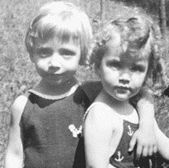
Renate and Rene Guttmann
were subjected to injection and x-ray
experiments by Josef Mengele.
(Courtesy of USHMM)
|
As the unsuspecting people were herded off the train
and ordered into separate lines, SS would shout
"Zwillinge!" ("twins!"). Parents were forced to make
a quick decision. Unsure of their situation, already
being separated from family members when forced to
form lines, seeing barbed wire, smelling an
unfamiliar stench - was it good or bad to be a twin?
Some parents
did announce their twins. Some relatives, friends,
or neighbors would announce the twins. Some mothers
tried to hide their twins. The SS and Mengele would
search through the surging ranks of people in search
of twins and anyone with unusual traits. While many
twins were either announced or discovered, some sets
of twins were successfully hidden and walked with
their mother into the gas chamber.
Which was the
right decision - to announce or not to announce
their twins? I don't think there necessarily was
one. Approximately three thousand twins were pulled
from the masses on the ramp, most of them children;
only around two hundred survived.
When the twins
were found, they were taken away from their parents.
|
Once
the SS guard knew we were twins, Miriam
and I were taken away from our mother,
without any warning or explanation.
Our
screams fell on deaf ears. I remember
looking back and seeing my mother's arms
stretched out in despair as we were led
away by a soldier.
That
was the last time I saw her.1
|
As the twins
were led away to be processed, their parents and
family stayed on the ramp and went through
selection. Occasionally, if the twins were very
young Mengele would allow the mother to join her
children in order for their health to be assured for
the experiments.
Processing
After the twins
had been taken from their parents, they were taken
to the showers. Since they were "Mengele's
children," they were treated differently than other
prisoners. Besides the obvious, suffering through
medical experiments, the twins were often allowed to
keep their hair and allowed to keep their own
clothes.
The twins were
then tattooed. They were given a number from a
special sequence.2 They were then
taken to the twin's barracks where they were
required to fill out a form. The form asked for a
brief history and basic measurements such as age and
height. Many of the twins were too young to fill the
form out by themselves so the Zwillingsvater
("Twin's Father") helped them. (This inmate was
assigned to the job of taking care of the male
twins.) Once the form was filled out, the twins were
taken to Mengele. Mengele asked them more questions
and looked for any unusual traits.
Life
for the Twins
Each morning,
life for the twins began at six o'clock. The twins
were required to report for roll call in front of
their barracks no matter what the weather. After
roll call, they ate a small breakfast. Then each
morning, Mengele would appear for an inspection.
Mengele's
presence did not necessarily connote fear in the
children. He was often known to appear with pockets
full of candy and chocolates, to pat them on the
head, to talk with them, and sometimes even play.
Many of the children, especially the younger ones,
called him "Uncle Mengele."3
The twins were
given brief instruction in makeshift "classes" and
were sometimes even allowed to play soccer.4
The children were not required to do hard work and
had jobs like being a messenger. Twins were also
spared from punishments as well as from the frequent
selections within the camp.
Conditions for
the twins were one of the best in Auschwitz, until
the trucks came to take them to the experiments.
Experiments
Generally,
every day, every twin had to have blood drawn.
Blood, often in
large quantities, was drawn from twins' fingers and
arms, and sometimes both their arms simultaneously.
The youngest children, whose arms and hands were
very small, suffered the most: Blood was drawn from
their necks, a painful and frightening procedure.5
It was
estimated that approximately ten cubic centimeters
of blood was drawn daily.6
Besides having
blood drawn, the twins were to undergo various
medical experiments. Mengele kept his exact
reasoning for his experiments a secret. Many of the
twins that he experimented on weren't sure for what
purpose the individual experiments were for nor what
exactly what was being injected or done to them.
Each morning,
the twins would wonder what was in store for them
that day. Would their number be called? If yes, then
the trucks would pick them up and take them to one
of several laboratories.
The twins were
forced to undress and lay next to each other. Then
every detail of their anatomy was carefully
examined, studied, and measured. What was the same
was deemed to be hereditary and was different was
deemed to be the result of the environment. These
tests would last for several hours.
Blood tests
included mass transfusions of blood from one twin to
another.
In attempts to
fabricate blue eyes, drops or injections of
chemicals would be put in the eyes. This often
caused severe pain, infections, and temporary or
permanent blindness.
Mysterious
injections that caused severe pain. Injections into
the spine and spinal taps with no anesthesia.
Diseases, including typhus and tuberculosis, would
be purposely given to one twin and not the other.
When one died, the other was often killed to examine
and compare the effects of the disease.
Various
surgeries without anesthesia including organ
removal, castration, and amputations.
|
One
day, my twin brother, Tibi, was taken
away for some special experiments.
Dr. Mengele had always been more
interested in Tibi. I am not sure why -
perhaps because he was the older twin.
Mengele
made several operations on Tibi. One
surgery on his spine left my brother
paralyzed. He could not walk anymore.
Then they took out his sexual organs.
After the fourth operation, I did not
see Tibi anymore.
I
cannot tell you how I felt. It is
impossible to put into words how I felt.
They had taken away my father, my
mother, my two older brothers - and now,
my twin.7
|
.
Dr Miklos
Nyiszli was Mengele's prisoner pathologist. The
autopsies became the final experiment. Dr. Nyiszli
performed autopsies on twins whom had died from the
experiments or whom had been purposely killed just
for after-death measurements and examination. Some
of the twins had been stabbed with a needle that
pierced their heart and then were injected with
chloroform or phenol which caused near immediate
blood coagulation and death.
Some of the
organs, eyes, blood samples, and tissues would be
sent to Verschuer for further study.
Notes
1. Eva Mozes as
quoted in Lucette Matalon Lagnado and Sheila Cohn
Dekel, Children of the Flames: Dr. Josef Mengele and
the Untold Story of the Twins of Auschwitz (New
York: William Morrow and Company, Inc., 1991) 56.
2. Robert Jay
Lifton, The Nazi Doctors: Medical Killing and the
Psychology of Genocide (BasicBooks, 1986) 348.
3. Lagnado,
Children 68.
4. Lagnado,
Children 67.
5. Lagnado,
Children 62.
6. Lifton, Nazi
350.
7. Moshe Offer
as quoted in Lagnado, Children 71.
Bibliography
Lagnado,
Lucette Matalon and Sheila Cohn Dekel. Children of
the Flames: Dr. Josef Mengele and the Untold Story
of the Twins of Auschwitz.
New York: William Morrow and Company, Inc., 1991.
Lifton, Robert
Jay. The Nazi Doctors: Medical Killing and the
Psychology of Genocide. BasicBooks, 1986.
Nyiszli, Dr.
Miklos. Auschwitz: A Doctor's Eyewitness Account.
1960. New York: Arcade Publishing, 1993.

