 MONTREAL -- Honour
thy mother.
MONTREAL -- Honour
thy mother.
That's the
motto Montrealer Angela Polgar has tried to live
by all her life - a life that began in a death
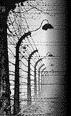
camp. The place was Auschwitz-Birkenau, in
southern Poland. Her parents, Hungarian Jews,
arrived there on a Nazi transport on May 25, 1944.
Polgar's
mother, Vera Bein, nee Otvos, was 25 years old at
the time and almost two months pregnant.
On the
infamous railway platform where "selections" were
made, Bein, as Polgar respectfully calls her, was
not sent to the gas chambers. Instead, she was
assigned to a variety of grueling work details
before becoming a guinea pig for sterilization
experiments by a camp doctor.
By the
horrific standards of the Holocaust, it's an
ordinary story, perhaps - except for one thing.
The patient survived, and so did her child.
On Dec. 21
Bein felt labour pains. She climbed to the top
bunk in her barrack, and there, aided by two other
inmates, gave birth in secret to a baby girl.
The infant
was tiny, weighing only one kilogram; she was too
weak to cry but strong enough to drink the meagre
offering from her mother's breast, and somehow
survived the next few weeks in hiding.
Soviet Red
Army troops liberated the camp on Jan. 27, 1945.
Baby and mother were among the survivors, and they
were an unusual sight - indeed, almost unique.
The only
other infant survivor, according to Auschwitz
museum records, was a Hungarian boy, Gyorgy
Faludi, born the day of liberation with the help
of a Russian doctor.
This week
18,000 people, including more than 1,000
Canadians, are gathering in Poland for the annual
March of the Living, a symbolic tour of the
Holocaust killing grounds whose centrepiece is
Auschwitz-Birkenau.
Marking
Holocaust Remembrance Day (in Hebrew, Yom Hashoah)
on Thursday, the Jewish-funded event will be the
largest such gathering since the march was
inaugurated in 1988.
Angela Polgar
isn't going. Instead, she has decided now is the
right time to tell Canadians her family's
remarkable story.
She isn't
doing it to shine light on herself; she even
refuses to have her picture taken, for fear people
would accuse her of self-aggrandizement.
Rather, she
wants to honour her mother, a woman who never
liked to talk about her experience because she
thought it would be a burden to her daughter.
"She was a
very, very special lady," said Polgar, a former
clothing store owner who lives in the Cote des
Neiges district of Montreal with her husband,
Joseph.
"My mother
felt so terrible for all the people who had lost
their children. They lost their babies, and she
brought one back," Polgar said.
"And at the
same time she didn't want me to have the memories
she had. So she didn't talk about it."
Telling it
now is a release - and a duty. "It has nothing to
do with me, this story. She did it. She's the one
who went through all this."
And so Angela
Polgar begins her story.
That both
mother and daughter survived at all is a miracle
in itself. About 1.1 million people, mostly Jews,
were exterminated at Auschwitz between the start
of the organized killing in March 1942 and its end
in November 1944. The death machine was at its
busiest the summer that Polgar's parents and other
Hungarian Jews arrived en masse to be liquidated -
more than 132,000 a month, according to Canadian
scholar Robert Jan van Pelt's exhaustive study,
Auschwitz: 1270 to the Present.
"By the end
of June, in just two months, half of Hungary's
Jewry - 381,661 souls - had arrived at Auschwitz,"
van Pelt wrote in the 1996 book he co-authored
with U.S. scholar Deborah Dwork. "At no other time
was Auschwitz more efficient as a killing center."
They quote
one survivor, Alexander Ehrmann, who arrived at
Birkenau at night and was aghast at what he saw
and heard - especially the piles of burning
bracken and rubble he saw and smelled through the
barbed wire.
From the
pyres came the sounds of children. "I heard a baby
crying. The baby was crying somewhere in the
distance and I couldn't stop and look. We moved,
and it smelled, a horrible stench. I knew that
things in the fire were moving, there were babies
in the fire."
At selection
on the platform, most visibly pregnant women were
sent to die; so were babies, children, the
obviously sick and the elderly. Others were spared
for use as slave labour or fodder for medical
experimentation.
Some of the
inmates in Camp C, Auschwitz's barrack for
Hungarian Jewish women and girls, were able to
bring their pregnancies to term, but their babies
were almost invariably taken from them right after
and killed - "mercifully" strangled to death by
Jewish inmate doctors forced to work for the
Nazis.
Most
pregnancies never got that far; the usual
clandestine practice was to abort fetuses before
they could be born - a life-saving measure for the
mother, who was an easy target for liquidation if
her pregnancy became too obvious.
One of the
Jewish physicians who routinely performed this
"service" at Auschwitz, a Hungarian gynecologist
named Gisella Perl, described that and worse in
her 1948 memoir I Was a Doctor in Auschwitz.
Walking by
one of the crematoriums one day, she witnessed
what happened to one group of women who, promised
better treatment, had revealed to their Nazi
overlords that they were pregnant. "They were
surrounded by a group of SS men and women, who
amused themselves by giving these helpless
creatures a taste of hell, after which death was a
welcome friend," Perl recalled in her book.
"They were
beaten with clubs and whips, torn by dogs, dragged
around by their hair and kicked in the stomach
with heavy German boots. Then, when they
collapsed, they were thrown into the crematory -
alive."
Vera Bein
escaped that fate. For the longest while, she kept
her pregnancy secret, and was lucky her delivery
came within weeks of liberation by the Soviets,
unannounced, and not "helped" by any camp doctor.
Her survival
- and that of her daughter - is a footnote of the
Holocaust, but an important one.
"This does
seem to be an unusual story," said Estee Yaari,
foreign media liaison for the Yad Vashem Holocaust
museum in Jerusalem. "Although there are others,"
she said, including one survivor born in
Buchenwald in 1944, "it is a rather rare
occurrence."
Surviving
Auschwitz was one thing. Little "Angi", as her
mother called her, was also lucky to have survived
the war's chaotic aftermath, overcoming a bad
start from poor nutrition that made her bones
weak.
She was even
lucky to get official proof of her arrival in this
world: a birth certificate that her adoptive
father got for her before the family left Poland.
Prepared in
1945 in Oswiecim, the Polish name for Auschwitz,
the certificate gave her name as "Angela Bein."
The surname was that of her biological father,
Tibor Bein, a lawyer, who died of maltreatment in
the camp.
"Auschwitz"
was listed as her place of birth - a place that
has ceased to exist by the German name, except as
an expression synonymous with mechanized murder.
Auschwitz today exists only as a museum, and
Angela Polgar has never been back.
She has a
copy of her birth certificate, issued in 1989 by
the Communist authorities in her hometown,
Sarospatak, in eastern Hungary.
As further
proof, she has her original 1966 Hungarian
teacher's diploma, which also lists Auschwitz as
her birthplace.
After the
liberation in 1945, Polgar's mother trekked across
parts of Poland, Romania and Byelorussia in a
circuitous route leading back to safety in
Hungary. There, Vera remarried, and it was that
second husband - Sandor Polgar, also an Auschwitz
survivor, owner of a textile shop and a generation
older than Vera - who adopted Polgar and become
her "real" father, the only one she ever knew.
Twelve years
later, however, he, too, died, and mother and
child were once again set adrift. Coming on the
heels of the crushing of their country's
revolution by the Soviets in 1956, and with a
relative now in Canada to sponsor them, they
started plotting their flight from Hungary. Vera
left in 1966, Angela followed in 1973 with her own
daughter, Katy. They settled in Toronto, where
Vera worked as a kindergarten teacher and
bookkeeper. Katy moved to Montreal and started a
family, and in 1996 Vera moved here to be with
them.
For the
longest time, the family saga - especially the
Auschwitz part - was kept private. The only public
recounting came in the form of a short memoir,
written in Angela Polgar's voice by her
sister-in-law, a retired Montreal high
schoolteacher named Marianne Bolgar. It was
published in a small Zionist journal in New York
in 2000.
Then, last
January, after a barrage of coverage in the media
about the 60th anniversary of the liberation of
Auschwitz, Polgar decided the time had come to let
the whole story be told. Polgar also unearthed a
precious resource: an old audio tape of her mother
recounting her time at Auschwitz. It was an
"interview" Vera gave her granddaughter, Katy, in
1984 for a high-school project. The tape - her
final word on the subject - will soon be
registered as part of the Auschwitz-Birkenau
Museum's archives in Poland.
As
testimonies go, it's a poignant one: words spoken
over the telephone more than 25 years ago, a
30-minute inter-generational dialogue in which the
subject sounds like she'd rather not be telling
the innocent teenager just how horrible history
can be.
"It's so
painful to talk about this," Vera says at one
point, as Katy prods her for details. "I was so
curious to hear what she had to say," Katy, now
doing her doctorate in cancer research at McGill
University, recalled last week.
"My mother
was so protective; she wouldn't let me read any
Holocaust books, so this was my one-time shot to
see what my grandmother could give me. The amazing
thing was that she was never bitter about what
happened to her. She just went on with life."
On the tape,
Vera begins by describing the confusion of her
arrival at Auschwitz in May, 1944. She remembers
the infamous Dr. Josef Mengele sending her to the
left after inspection on the platform while others
were sent to the right, to their deaths. Worried
she was being separated from the others and
unaware of her good fortune to be spared, she
remembers telling Mengele she was pregnant, hoping
he'd be compassionate and let her stay with the
others.
"You stupid
goose!" she recalled Mengele snapping at her,
ordering her to do as she was told. Healthy and
strong, Vera was good stock for the camp's labour
force. Mengele wasn't going to send her to her
death, not yet.
She was sent
to have her left arm tattooed with a registration
number: A-6075. Then she was assigned the night
shift in the ample storeroom in Camp A that
contained mounds of confiscated belongings of
other Auschwitz victims and inmates.
Because it
was so rich in stock, the depot was dubbed
"Kanada," like the land of plenty. Vera's job was
to sort clothing, shoes, bedding - anything the
Germans wanted to keep for themselves.
Later, she
was assigned kitchen duty, where she ate potato
peels, a slight but vital source of nutrition for
her and the child inside her. The rest of her
daily diet consisted of ersatz coffee in the
morning," something warm, a soup made of grass"
for lunch, and for supper a slice of bread with a
smear of jam or margarine on it.
Then came
hard labour outside the camp, building a road and
working in afield. Vera was transferred to Camp
B2, then Camp C, where she got to know children,
especially twins, who were used for medical
experiments by Mengele and fellow doctors before
being liquidated.
It was only a
matter of time before she became a guinea pig
herself.
In October,
now seven months pregnant, she was selected by
Prof. Carl Clauberg's medical team for
sterilization experiments. They injected some kind
of burning, caustic substance into her cervix.
Right behind,
in the uterus, was the fetus.
"That was me
in there," Polgar now marvels. "The needles went
in, I went to the right side, then the left side.
Who knows what he gave her?"
Somehow the
fetus survived. After the experiment was over, the
patient went back to her barracks - and then
disappeared from the doctors' radar.
"Somehow
Mengele forgot her," Polgar said. "I was so small,
the pregnancy didn't really show. That was her
luck. Otherwise, they would have finished her off,
and me, too."
A month
later, Vera was approached in her barracks by "a
Jewish woman doctor"- possibly the gynecologist
Gisella Perl.
The doctor
had a warning and an offer. She told her that new
mothers usually "disappeared" along with their
offspring after the birth - sent to the gas
chambers. She offered to give Vera an abortion.
"I promised
her to think it over, because she really insisted
on it," Vera recalled on the tape. "She said I was
too young to be gassed, and she wanted to save me.
"But that night, Vera dreamt of her mother. "She
told me, 'Veruska, you are eight months pregnant,
and you don't do this, because (the fetus is)
alive already and ready to leave. Believe in God
and Hashem will be with you. Maybe a miracle will
happen. But don't do it.'
"The next
day, Vera gave the doctor her answer: she was
going ahead with the birth. It happened on Dec.
21, in the barracks of Camp C. "I felt the pain
and told the Block altester (the
barrack's inmate supervisor) that I feel cramps
and pain. She asked me to climb on the top of the
bunk, and she came with me and she helped me to
give birth to your mummy," Vera tells her
granddaughter on the tape. "She knew how to do it,
because she was the daughter of a doctor, so she
had an idea about cleanliness and how to help a
woman in labour. She brought hot water and clean
sheets. She cooked a pair of scissors in hot water
to sterilize them" before cutting the umbilical
cord, she said. "So everything went quite easily.
"The infant weighed one kilogram, a little over
two pounds "Mummy was so weak and so tiny, she
didn't cry. So nobody knew she was born."
Three hours
after giving birth, Vera had to leave her baby in
the bunk and go outside in the cold for roll call
- what the Germans called the Appell.
Her daughter
is still amazed she was able to do it. "What
courage, what incredible strength she had to do
that," Polgar said. "Remember, it was December. It
was freezing, and they didn't have any coats or
proper shoes, just wooden clogs that made them
slip on the ice."
Just before
the liberation, a final scare. Yelling "Schnell!
Schnell!"(Quick! Quick!) the German guards herded
surviving inmates like Vera into a tunnel beneath
the camp and told them they would be exterminated.
(It didn't happen, but to her dying day Vera
retained a mortal fear of tunnels; once, trapped
between stations in a stalled Toronto subway car,
she lost her senses, screaming to be let out.)
After the
scare, there was another miracle.
On the day of
liberation another child was born at Auschwitz,
Gyorgy Faludi.
His mother
had helped Vera with her delivery; now Vera
returned the favour.
The woman
didn't have enough milk to suckle her son, so Vera
did it. It was the beginning of a long friendship.
The two families - Faludi with her son, Bein with
her daughter - stuck together for the next few
months of wandering back to Hungary. Vera nursed
the two children and helped Faludi find her
husband and return to their hometown, Miskolc. The
war was over. Now the recovery began. After the
liberation, no-one except Vera held up much hope
that little Angelawould live long.
In Budapest,
Vera's mother's advice was to let the baby die.
So, too, saidthe local doctors they consulted -
until one of them did a closer examination."(He)
held me up like a chicken, by the legs with my
head down. He wanted to see if I'd try to pull my
head up. And I did. And then he said 'We can let
that baby live.' "Her biggest problem in those
first few years were her bones. "They were very
weak, and I wasn't allowed to walk. So they put me
in a carriage, and my father took me back and
forth to school that way," she said.
In the
street, strangers used to stare." Everybody looked
at me ... and said 'That's a doll, not a baby.'
They called my mother the crazy lady, because they
thought she was only pretending to have a baby."
Over time, though, with better nutrition and care,
the child's bones got stronger, and at six she
could finally walk unaided. The legacy of Angela's
early years never disappeared completely. She's
still tiny of stature, under five feet tall, and
walks with a shuffling gait. But that doesn't seem
to faze her. These days, she bustles back and
forth to a computer class she takes in Montreal
and doesn't seem handicapped by her physique - or
her past.
Sixty years
after her birth she's been thinking a lot about
her mother. She remembers her on her death bed, 13
years ago in a Toronto hospital. It was a sad,
cruel end to a remarkable life. Vera's body was
ridden with cancer of the spine and lung. While
she lay dying, paralyzed, she had visions of
Auschwitz. "She would say 'Mengele is at the
door,' " Polgar said. "It was horrible. There was
not enough morphine to take the nightmare away
even from her dying minutes."
Vera Polgar,
previously Vera Bein, born Veronika Otvos, died at
age 73 on Jan. 28, 1992 - a day after the
anniversary of the liberation of Auschwitz. "She
did not want to die on Jan. 27," Polgar said. "She
pulled the suffering through to the next day to
die."
She remembers
her mother for many things: the odds she overcame,
the perseverance she embodied, the pain she
concealed for so many years under a mask of
optimism and a survivor's dream of renewal.
"She was very
charming, never depressed," Polgar said. "But deep
down, it was always there."
Like the ink
in the number tattooed on her arm, the mark that
Auschwitz left on Vera's psyche was indelible.
Now, thanks to her daughter, so is her story.
©
2005
[*] Original title
"Canadian" rather than "Hungarian"



